2024 Wheat Variety Yield Loss and Fungicide Tests and Stripe Rust Survey in November
A. Yield losses caused by stripe rust and increases by fungicide application on wheat varieties tested in 2024
The experiment for assessing yield losses caused by stripe rust on 23 major winter wheat varieties grown in the Pacific Northwest (PNW), in comparison to susceptible check ‘PS279’, was conducted on the Palouse Conservation Farm Station (PCFS), near Pullman, WA in a randomized split-block design with four replications for each treatment. The field was planted on October 30, 2023. Natural stripe rust was first observed in the experimental field on April 9, 2024. Fungicide Quilt Xcel (14 fl oz/A) was sprayed in the fungicide-sprayed plots of each variety at the early jointing stage (Feekes 5) on May 15 when stripe rust was found at 1-5% severity in the PS279 plots and sprayed again at the boot stage (Feekes 10) on May 30 for the spray plots when the non-spray plots of PS279 had stripe rust of 25-40% severity. Over the season, stripe rust was scored for infection type and severity for each plot four times during the rust season, and the relative area under the disease progress curve (rAUDPC) was calculated from the multiple sets of the severity data. Grain test weight and yield were measured and calculated for each plot after harvest. The average values of stripe rust rAUDPC, grain test weight and yield for the no-spray and fungicide-sprayed plots of the 24 varieties are shown in Table 1.
Under the severe natural stripe rust epidemic, the disease reduced grain test weight by 5.2 pounds per bushel (9.0%) and grain yield by 61.2 bushels per acre (56.1%) in the susceptible check (PS279). For the 23 commercially grown varieties, the average yield loss was 10.1 bushels per acre (7.5%) and the average test weight reduction was 0.7 pounds per bushel (1.2%), indicating that the resistance in the commercially grown varieties were able to reduce the yield loss from 56% to 7.5%. However, commercially grown varieties varied significantly in stripe rust resistance and yield loss. Although better than the susceptible check, ‘UI Magic’ had the highest yield loss (52.6 bushels per acre or 40.4%) among the commercially grown varieties, followed by ‘Curiosity CL+’ (26.1 bushels per acre or 18.8%) and ‘LCS Jet’ (25.1 bushels per acre or 18.1%). Based on the yield loss data, UI Magic received fungicide rating 2, indicating the need of fungicide application. Seven varieties (LCS Jet, ‘Otto’, ‘Keldin’, ‘Mela Cl+’, ‘LCS Helix’, ‘Northwest Duet’, and ‘ARS-Crescent’) were rated 1 for fungicide rating, indicating that these varieties might or might not need fungicide application. The remaining fifteen varieties (‘Stinggray CL+’, ‘LCS Shine’, ‘Catella’, ‘Northwest Tandem’, ‘AP Lliad’, ‘Pritchett’, ‘LCS Blackjack’, ‘LCS Artdeco’, ‘Piranha CL+’, ‘SY Assure’, ‘M-Press’, ‘Resillence CL+’, ‘LCS Hulk’, and ‘SY Dayton’) showed high levels of stripe rust resistance, did not have significant yield losses, and were rated fungicide rating 0, indicating that these varieties did no need of fungicide application in this location.
| Variety | CVR No. |
rAUDPC (%) | Test Weight (LB/BU) | Yield (BU/A) | Yield loss (%) by stripe rust |
Yield Inc. (%) by fungicide |
Relative yield loss (%) |
Fungicide ratingb |
|||||||||
|---|---|---|---|---|---|---|---|---|---|---|---|---|---|---|---|---|---|
| No spray | Spraya | Reduction | No spray | Spraya | Increase | No spray | Spraya | Difference | |||||||||
| PS279 | 1 | 100.0 | 9.6 | 90.4 | * | 52.4 | 57.6 | 5.2 | * | 47.9 | 109.0 | 61.2 | * | 56.1 | 127.8 | 100.0 | 2 |
| UI Magic | 4 | 36.9 | 3.9 | 33.0 | * | 54.5 | 59.6 | 5.1 | * | 77.6 | 130.2 | 52.6 | * | 40.4 | 67.8 | 72.0 | 2 |
| Curiosity CL+ | 2 | 21.1 | 6.7 | 14.4 | * | 52.5 | 52.4 | -0.2 | 112.4 | 138.4 | 26.1 | * | 18.8 | 23.2 | 33.5 | 1 | |
| LCS Jet | 14 | 19.2 | 5.1 | 14.1 | * | 58.7 | 60.0 | 1.3 | 114.0 | 139.2 | 25.1 | * | 18.1 | 22.0 | 32.2 | 1 | |
| Otto | 11 | 12.3 | 4.5 | 7.8 | * | 53.6 | 52.9 | -0.6 | 119.7 | 144.2 | 24.5 | * | 17.0 | 20.4 | 30.2 | 1 | |
| Keldin | 17 | 17.0 | 4.0 | 13.0 | * | 60.3 | 61.2 | 0.9 | 103.9 | 119.1 | 15.2 | 12.8 | 14.7 | 22.8 | 1 | ||
| Mela CL+ | 15 | 15.7 | 6.9 | 8.8 | * | 56.1 | 57.4 | 1.3 | 118.7 | 134.8 | 16.0 | 11.9 | 13.5 | 21.2 | 1 | ||
| LCS Helix | 19 | 20.9 | 6.2 | 14.7 | * | 61.8 | 62.7 | 0.9 | 105.1 | 117.7 | 12.6 | 10.7 | 11.9 | 19.0 | 1 | ||
| Northwest Duet | 21 | 3.4 | 3.2 | 0.2 | 57.8 | 58.2 | 0.5 | 145.0 | 159.0 | 14.0 | 8.8 | 9.7 | 15.7 | 1 | |||
| ARS-Crescent | 16 | 13.8 | 2.8 | 11.0 | * | 55.8 | 55.9 | 0.1 | 116.1 | 125.2 | 9.1 | 7.3 | 7.8 | 13.0 | 0 | ||
| Stingray CL+ | 9 | 6.8 | 6.3 | 0.5 | 54.9 | 55.1 | 0.2 | 112.8 | 121.0 | 8.1 | 6.7 | 7.2 | 12.0 | 0 | |||
| LCS Shine | 12 | 1.7 | 1.6 | 0.1 | 59.3 | 60.0 | 0.7 | 138.1 | 147.9 | 9.8 | 6.6 | 7.1 | 11.8 | 0 | |||
| Castella | 13 | 14.2 | 4.5 | 9.7 | * | 58.1 | 59.1 | 1.0 | 116.7 | 121.9 | 5.1 | 4.2 | 4.4 | 7.5 | 0 | ||
| Northwest Tandem | 23 | 2.3 | 2.8 | -0.6 | 58.4 | 58.6 | 0.1 | 133.8 | 138.5 | 4.8 | 3.4 | 3.6 | 6.1 | 0 | |||
| AP Iliad | 24 | 2.4 | 2.2 | 0.3 | 60.1 | 59.9 | -0.3 | 137.6 | 141.5 | 3.9 | 2.8 | 2.8 | 4.9 | 0 | |||
| Pritchett | 7 | 5.5 | 2.0 | 3.5 | 56.2 | 56.8 | 0.7 | 141.6 | 145.4 | 3.8 | 2.6 | 2.7 | 4.7 | 0 | |||
| LCS Blackjack | 22 | 3.7 | 3.4 | 0.3 | 55.3 | 56.4 | 1.1 | 142.0 | 145.0 | 3.1 | 2.1 | 2.1 | 3.7 | 0 | |||
| LCS Artdeco | 5 | 8.5 | 3.8 | 4.7 | * | 56.3 | 57.2 | 1.0 | 126.4 | 129.1 | 2.7 | 2.1 | 2.1 | 3.7 | 0 | ||
| Piranha CL+ | 6 | 2.2 | 1.5 | 0.7 | 56.3 | 57.3 | 1.0 | 135.8 | 137.3 | 1.5 | 1.1 | 1.1 | 2.0 | 0 | |||
| SY Assure | 18 | 2.4 | 2.3 | 0.2 | 61.5 | 61.5 | 0.0 | 130.8 | 131.5 | 0.6 | 0.5 | 0.5 | 0.8 | 0 | |||
| M-Press | 20 | 4.5 | 4.3 | 0.3 | 58.6 | 58.7 | 0.1 | 131.6 | 131.2 | -0.4 | -0.3 | -0.3 | -0.5 | 0 | |||
| Resilience CL+ | 10 | 6.1 | 6.1 | 0.0 | 57.9 | 58.4 | 0.5 | 131.6 | 130.2 | -1.4 | -1.1 | -1.1 | -1.9 | 0 | |||
| LCS Hulk | 3 | 8.3 | 9.8 | -1.5 | 58.8 | 59.8 | 1.0 | 137.1 | 135.6 | -1.5 | -1.1 | -1.1 | -2.0 | 0 | |||
| SY Dayton | 8 | 5.1 | 4.0 | 1.1 | 58.0 | 57.5 | -0.6 | 125.4 | 122.4 | -2.9 | -2.4 | -2.4 | -4.3 | 0 | |||
| Mean | 13.9 | 4.5 | 9.4 | * | 57.2 | 58.1 | 0.9 | 120.9 | 133.1 | 12.2 | 9.2 | 10.1 | 16.4 | 0 | |||
| Mean (excl.PS279) | 10.2 | 4.3 | 5.9 | * | 57.4 | 58.1 | 0.7 | 124.1 | 134.2 | 10.1 | 7.5 | 8.1 | 13.4 | 0 | |||
| R2 | 0.96 | 0.70 | 0.58 | ||||||||||||||
| CV | 37.61 | 3.31 | 14.06 | ||||||||||||||
| p-value | <0.0001 | <0.0001 | <0.0001 | ||||||||||||||
| LSD (P = 0.05) | 4.83 | 2.67 | 24.96 | ||||||||||||||
| a Quilt Xcel at 14.0 fl oz/A was sprayed first time at early jointing stage (Feekes 5) on 15 May when stripe rust was absent in the field, | |||||||||||||||||
| and second time on 30 May when plants were at boot stage (Feekes 10) and the non-first spray PS279 plots had 0-0.1% stripe rust severity. | |||||||||||||||||
| b Rating = the single digit number of yield difference/LSD. Varieties with rating 0 does not need fungicide application, those with rating 1 may or | |||||||||||||||||
| may not need fungicide application, and those with rating 2 or higher need application. | |||||||||||||||||
| * The difference between the non-sprayed check and fungicide spray plots is significant at P ≤ 0.05. | |||||||||||||||||
A similar experiment was conducted for 24 spring wheat varieties on the Spillman Farm, near Pullman. The field was planted on May 1, 2024, and stripe rust was not observed in the field until June 20 when the plants reached the boot stage. Fungicide Quilt Xcel (14 fl oz/A) was sprayed in the fungicide-sprayed plots on June 13 (Feekes 4-5) without observed stripe rust and again on June 28 (Feekes 10.1). Stripe rust infection type and severity data were scored four times from Feekes 5 to Feekes 11.1. Grain yield and test weight were measured and calculated for each plot after harvest. The average values of stripe rust rAUDPC, grain test weight and yield are shown in Table 2. Stripe rust reduced grain test weight by 3.1 pound per bushel (5.0%) and grain yield by 20.1 bushels per acre (29.6%) in the non-spray plots of the susceptible check ‘AvS’. The average yield loss for the 23 commercially grown varieties was 4.5%. Among the commercially grown varieties, ‘UI Stone’ suffered the highest damage, test weight reduction of 1.9 pound per acre (3.1%) and yield reduction of 19.0 bushel per acre (22.1%). Both AvS and UI Stone were rated 2 for fungicide rating, indicating the need of fungicide application. Six commercially grown varieties (‘Kelse’, ‘Net CL+’, ‘Expresso’, ‘Roger’, ‘UI Cookie’, and ‘Alum’) had yield losses ranging from 14.9% to 8.6% in the sequential order but the losses were statistically insignificant. These varieties received fungicide rating 1, indicating that they might or might not need fungicide application. The remaining sixteen commercially grown varieties (‘WB9668’, ‘Chet’, ‘Buck Pronto’, ‘Melba’, ‘Louise’, ‘WA 8351’, ‘AP Mondovi’, ‘Ryan’, ‘Seahawk’, ‘Hale’, ‘Hedge CL+’, ‘AP Venom’, ‘Glee’, ‘Tekoa’, ‘JD’, and ‘WB9662’) showed high levels of resistance, had insignificant or no yield losses, and were rated 0 for fungicide application ratings, indicating that they did not need fungicide application.
| Variety | CVR No. |
rAUDPC (%) | Test Weight (LB/BU) | Yield (BU/A) | Yield loss (%) by stripe rust |
Yield Inc. (%) by fungicide |
Relative yield loss (%) |
Fungicide ratingb |
|||||||||
|---|---|---|---|---|---|---|---|---|---|---|---|---|---|---|---|---|---|
| No spray | Spraya | Reduction | No spray | Spraya | Increase | No spray | Spraya | Difference | |||||||||
| AvS | 1 | 100.0 | 6.5 | 93.5 | * | 59.4 | 62.5 | 3.1 | * | 47.9 | 68.0 | 20.1 | * | 29.6 | 42.0 | 100.0 | 2 |
| UI Stone | 17 | 48.3 | 7.5 | 40.7 | * | 59.1 | 61.0 | 1.9 | * | 66.9 | 85.9 | 19.0 | * | 22.1 | 28.5 | 74.8 | 2 |
| Kelse | 10 | 62.0 | 8.5 | 53.5 | * | 58.9 | 60.1 | 1.2 | 59.6 | 70.1 | 10.5 | 14.9 | 17.6 | 50.5 | 1 | ||
| Net CL+ | 7 | 33.9 | 8.2 | 25.7 | * | 61.1 | 61.6 | 0.5 | 60.5 | 68.7 | 8.2 | 11.9 | 13.6 | 40.4 | 1 | ||
| Expresso | 5 | 9.5 | 9.1 | 0.3 | 59.8 | 60.6 | 0.8 | 56.2 | 63.6 | 7.5 | 11.7 | 13.3 | 39.6 | 1 | |||
| Roger | 11 | 28.0 | 6.0 | 22.0 | * | 61.1 | 61.5 | 0.4 | 64.8 | 71.9 | 7.1 | 9.9 | 11.0 | 33.4 | 1 | ||
| UI Cookie | 14 | 31.8 | 4.5 | 27.3 | * | 58.3 | 59.2 | 0.9 | 76.1 | 84.3 | 8.1 | 9.7 | 10.7 | 32.6 | 1 | ||
| Alum | 24 | 20.0 | 6.6 | 13.3 | * | 59.9 | 60.3 | 0.4 | 63.4 | 69.4 | 6.0 | 8.6 | 9.5 | 29.2 | 1 | ||
| WB9668 | 8 | 5.0 | 8.0 | -3.0 | 60.3 | 60.6 | 0.3 | 53.4 | 58.1 | 4.7 | 8.1 | 8.9 | 27.5 | 0 | |||
| Chet | 2 | 19.2 | 5.9 | 13.3 | * | 61.7 | 61.4 | -0.2 | 66.2 | 70.8 | 4.6 | 6.5 | 7.0 | 22.1 | 0 | ||
| Buck Pronto | 19 | 41.1 | 8.2 | 32.9 | * | 59.1 | 61.1 | 2.0 | * | 68.0 | 72.1 | 4.1 | 5.7 | 6.0 | 19.2 | 0 | |
| Melba | 15 | 8.7 | 5.9 | 2.8 | 59.9 | 59.6 | -0.3 | 65.9 | 69.0 | 3.1 | 4.4 | 4.7 | 15.0 | 0 | |||
| Louise | 3 | 17.0 | 9.6 | 7.4 | * | 57.3 | 57.6 | 0.2 | 62.7 | 65.4 | 2.7 | 4.2 | 4.4 | 14.1 | 0 | ||
| WA 8351 | 22 | 8.4 | 7.0 | 1.4 | 61.5 | 61.6 | 0.1 | 71.7 | 73.7 | 2.0 | 2.8 | 2.8 | 9.3 | 0 | |||
| AP Mondovi | 20 | 11.6 | 7.6 | 4.0 | 59.0 | 58.8 | -0.2 | 71.0 | 72.5 | 1.5 | 2.1 | 2.1 | 7.0 | 0 | |||
| Ryan | 21 | 25.3 | 6.4 | 18.9 | * | 58.7 | 59.5 | 0.8 | 88.4 | 89.9 | 1.5 | 1.7 | 1.7 | 5.8 | 0 | ||
| Seahawk | 23 | 4.1 | 4.8 | -0.7 | 59.6 | 58.8 | -0.8 | 73.6 | 73.7 | 0.1 | 0.2 | 0.2 | 0.6 | 0 | |||
| Hale | 13 | 4.5 | 8.5 | -4.0 | 61.1 | 61.3 | 0.2 | 69.9 | 68.7 | -1.2 | -1.8 | -1.8 | -6.1 | 0 | |||
| Hedge CL+ | 9 | 8.6 | 7.5 | 1.1 | 60.6 | 60.5 | -0.1 | 71.7 | 70.3 | -1.4 | -1.9 | -1.9 | -6.6 | 0 | |||
| AP Venom | 6 | 9.8 | 4.9 | 4.9 | 59.8 | 58.0 | -1.8 | 68.7 | 66.7 | -2.0 | -2.9 | -2.9 | -10.0 | 0 | |||
| Glee | 16 | 35.7 | 8.9 | 26.8 | * | 59.7 | 60.3 | 0.6 | 69.0 | 66.5 | -2.5 | -3.8 | -3.6 | -12.7 | 0 | ||
| Tekoa | 4 | 7.7 | 8.6 | -1.0 | 60.8 | 60.8 | 0.0 | 79.5 | 75.5 | -3.9 | -5.2 | -5.0 | -17.6 | 0 | |||
| JD | 12 | 6.8 | 8.0 | -1.2 | 59.7 | 59.1 | -0.5 | 63.2 | 59.9 | -3.3 | -5.5 | -5.2 | -18.6 | 0 | |||
| WB9662 | 18 | 9.6 | 8.8 | 0.8 | 60.0 | 59.9 | -0.2 | 60.9 | 57.7 | -3.2 | -5.5 | -5.3 | -18.7 | 0 | |||
| Mean | 23.2 | 7.3 | 15.9 | * | 59.8 | 60.2 | 0.4 | 66.6 | 70.5 | 3.9 | 5.5 | 5.8 | 18.7 | 0 | |||
| Mean (excl.AvS) | 19.8 | 7.3 | 12.5 | * | 59.9 | 60.1 | 0.3 | 67.5 | 70.6 | 3.2 | 4.5 | 4.7 | 15.3 | 0 | |||
| R2 | 0.97 | 0.60 | 0.69 | ||||||||||||||
| CV | 22.97 | 1.91 | 9.78 | ||||||||||||||
| p-value | <0.0001 | <0.0001 | <0.0001 | ||||||||||||||
| LSD (P = 0.05) | 5.67 | 1.86 | 10.87 | ||||||||||||||
| a Quilt Xcel at 14.0 fl oz/A was sprayed first time at early jointing stage (Feekes 5) on 13 June when stripe rust was absent in the field, | |||||||||||||||||
| and second time on 28 Jun when plants were at boot stage (Feekes 10.1) and the non-first spray AvS plots had 10-20% stripe rust severity. | |||||||||||||||||
| b Rating = the single digit number of yield difference/LSD. Varieties with rating 0 does not need fungicide application, those with rating 1 may or may not | |||||||||||||||||
| need fungicide application, and those with rating 2 or higher need application. | |||||||||||||||||
| * The difference between the non-sprayed check and fungicide spray plots is significant at P ≤ 0.05. | |||||||||||||||||
B. Fungicide tests in 2024
In 2024, 15 fungicide treatments, plus a non-treated check, were evaluated for stripe rust control efficacy on a susceptible winter wheat variety (PS279) on the PCFS Farm near Pullman. This experiment was conducted using the completely randomized block design, near the winter wheat variety yield loss experiment. The dates of planting, fungicide applications, and data collections for stripe rust, grain test weight and yield were similar to the descriptions above. The average stripe rust severity values at each data collection point, as well as rAUDPC, test weight, and yield, for each treatment are given in Table 3.
All the fungicide treatments significantly reduced stripe rust rAUDPC and increased grain test weight and yield. The yield increases ranged from 24.1% by Quadris (6.0 fl oz/A) applied at Feekes 5 (Treatment No. 13) to 109% by Tilt (4.0 fl oz/A) applied at Feekes 5 plus Trivapro (13.7 fl oz/A) applied at Feekes 10 (Treatment No. 12). These results can be used to select fungicides and application timing based on the pattern and level of stripe rust development.
The fungicide treatments were also tested on a susceptible spring wheat variety (AvS). Due to the low level and nonuniformity of stripe rust, the efficacies of the treatments were not distinguishable.
| Treatment | Stripe rust severity (%)d | Test | Yield | |||||||||||||
|---|---|---|---|---|---|---|---|---|---|---|---|---|---|---|---|---|
| 14 May | 29 May | 12 Jun | 21 Jun | Relative | weightd | Meand | Increase | |||||||||
| No. | Fungicide, rate, timinga,b,c | E. jointing | Boot | Flowering | Milk | AUDPC | (lb/bu) | (bu/A) | % | |||||||
| 1 | No fungicide | 2.25 | AB | 32.5 | B | 70.0 | A | 97.8 | A | 100.0 | A | 54.2 | EF | 49.8 | J | 0.0 |
| 2 | Trivapro 9.4 fl oz/A at Fks 5; Trivapro 13.7 fl oz/A at Fks 10 | 2.00 | AB | 4.5 | CD | 5.0 | E | 7.5 | G | 9.9 | G | 59.7 | A | 93.9 | B | 88.6 |
| 3 | Quilt Xcel 7.5 fl oz/A at Fks 5; Quilt Xcel 7.5 fl oz/A at Fks 10 | 3.00 | A | 7.5 | CD | 7.5 | DE | 10.0 | G | 15.2 | FG | 59.2 | AB | 89.0 | BC | 78.7 |
| 4 | Tilt 4.0 fl oz/A at Fks 5 | 1.75 | B | 6.5 | CD | 63.8 | A | 98.5 | A | 74.1 | BC | 53.5 | FG | 65.4 | HI | 31.2 |
| 5 | Quilt Xcel 14.0 fl oz/A at Fks 5 | 2.25 | AB | 5.0 | CD | 48.8 | BC | 97.3 | A | 62.8 | D | 53.8 | FG | 71.1 | F-H | 42.8 |
| 6 | Trivapro 9.4 fl oz/A at Fks 5 | 2.50 | AB | 3.8 | D | 42.5 | BC | 97.3 | A | 57.7 | D | 55.9 | DE | 79.1 | D-F | 58.8 |
| 7 | Tilt 4.0 fl oz/A at Fks 10 | 2.50 | AB | 36.3 | AB | 48.8 | BC | 65.0 | B | 80.7 | B | 58.0 | A-C | 69.5 | G-I | 39.5 |
| 8 | Tilt 4.0 fl oz/A at Fks 5; Quilt Xcel 14.0 fl oz/A at Fks 10 | 2.50 | AB | 11.3 | C | 12.5 | DE | 17.5 | EF | 23.4 | EF | 58.3 | AB | 86.8 | BC | 74.3 |
| 9 | Trivapro 13.7 fl oz/A at Fks 10 | 2.00 | AB | 40.0 | A | 42.5 | BC | 60.0 | B | 78.2 | B | 58.3 | AB | 74.6 | FG | 49.8 |
| 10 | Quilt Xcel 14.0 fl oz/A at Fks 10 | 3.00 | A | 38.8 | AB | 41.3 | C | 50.0 | C | 74.1 | BC | 58.6 | AB | 77.3 | E-G | 55.3 |
| 11 | Tilt 4.0 fl oz/A at Fks 5; Tilt 4.0 fl oz/A at Fks 10 | 2.25 | AB | 6.3 | CD | 13.5 | DE | 20.0 | E | 20.4 | EF | 59.0 | AB | 83.6 | B-E | 67.9 |
| 12 | Tilt 4.0 fl oz/A at Fks 5; Trivapro 13.7 fl oz/A at Fks 10 | 2.50 | AB | 7.5 | CD | 10.0 | DE | 11.8 | FG | 17.1 | EF | 59.8 | A | 104.4 | A | 109.5 |
| 13 | Quadris 6.0 fl oz/A at Fks 5 | 2.25 | AB | 5.0 | CD | 51.3 | B | 99.0 | A | 64.9 | CD | 52.2 | G | 61.8 | I | 24.1 |
| 14 | Quadris 6.0 fl oz/A at Fks 10 | 2.00 | AB | 38.8 | AB | 41.3 | C | 66.3 | B | 77.9 | B | 57.4 | B-D | 73.9 | FG | 48.3 |
| 15 | Quadris 6.0 fl oz/A at Fks 5; Quadris 6.0 fl oz/A at Fks 10 | 2.25 | AB | 7.5 | CD | 15.0 | D | 35.0 | D | 26.3 | E | 56.4 | CD | 77.6 | E-G | 55.9 |
| 16 | Tilt 4.0 fl oz/A + Quadris 6.0 fl oz/A at Fks 5; Tilt 4.0 fl oz/A + Quadris 6.0 at Fks 10 | 2.00 | AB | 7.0 | CD | 7.0 | DE | 8.8 | G | 13.7 | FG | 59.2 | AB | 93.7 | B | 88.2 |
| R2 | 0.18 | 0.9 | 0.9 | 1.0 | 1.0 | 0.8 | 0.9 | |||||||||
| CV | 35.58 | 30.2 | 20.4 | 8.6 | 15.0 | 2.2 | 7.6 | |||||||||
| p-value | 0.76 | <0.0001 | <0.0001 | <0.0001 | <0.0001 | <0.0001 | <0.0005 | |||||||||
| LSD (P ≤ 0.05) | 1.17 | 6.93 | 9.43 | 6.45 | 10.62 | 1.78 | 8.47 | |||||||||
| a The application at Feekes 5 (early jointing) was done on 15 May, and at Feekes 10 (boot) on 30 May, 2024. | ||||||||||||||||
| b The field was under narural infection of the wheat stripe rust pathogen. | ||||||||||||||||
| c 0.25% v/v NIS was included in each application of all treatments. | ||||||||||||||||
| d Means sharing one or more letters are not significantly different at P = 0.05. | ||||||||||||||||
C. Stripe rust survey in November
On November 5, we were checking wheat fields in Whitman, Adams, Lincoln, Douglas, and Grant counties in eastern Washington. Winter wheat generally had very good emergency with plants ranging from early tillering (Feekes 2) to early jointing (Feekes 5). We checked over 30 fields with big plants (Feekes 3-5) and found only two stripe rust-infected leaves in one field along Highway 2 in Lincoln County (Figure 1). Whether the stripe rust fungus in the infected field is able to survive the winter or not will depend upon how cold of the winter and snow cover. We will provide stripe rust forecasts based on the winter weather data and conduct field survey in the early spring.
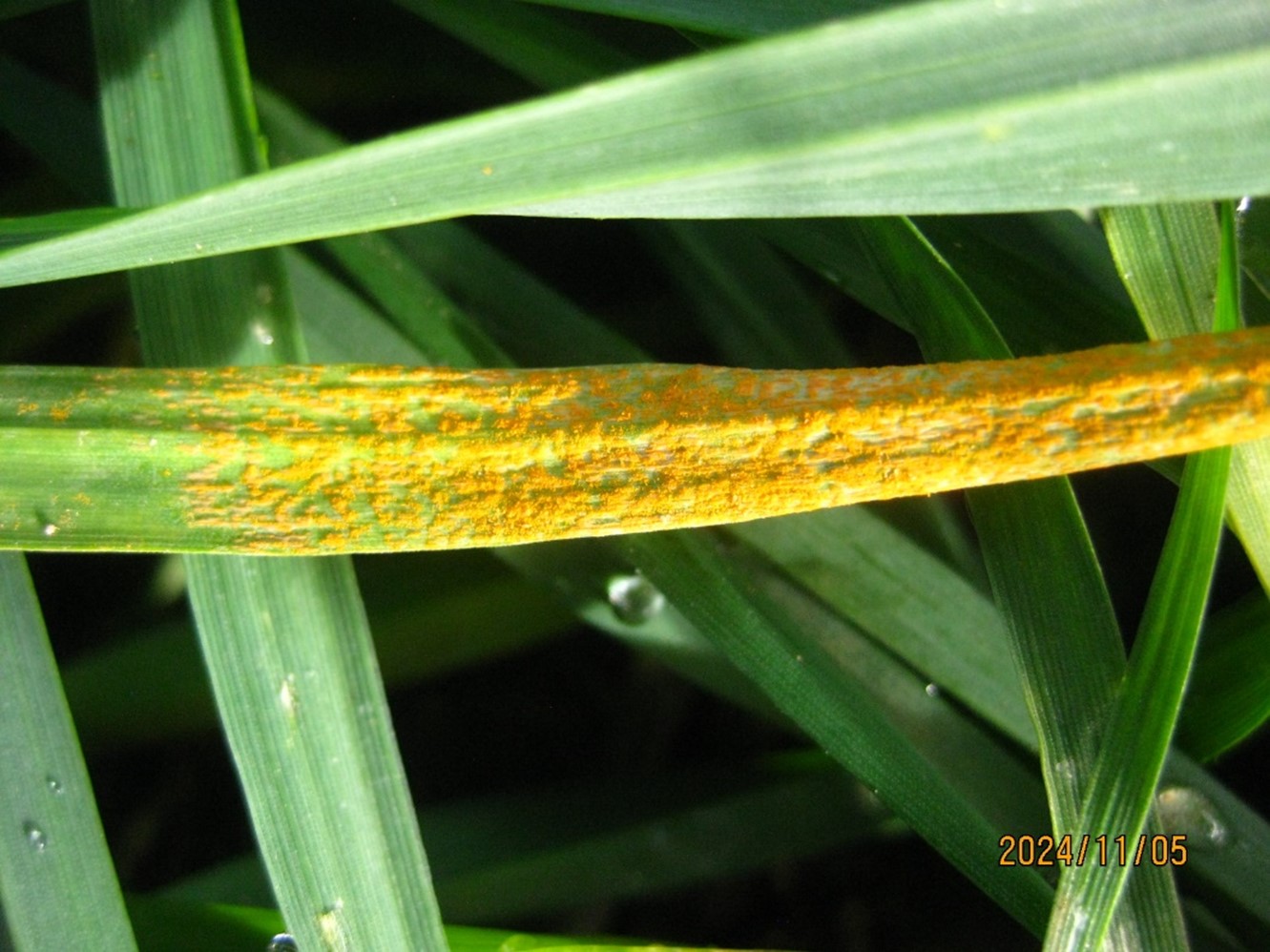
Figure 1. Stripe rust observed in a winter wheat field in Lincoln County, Washington on November 5, 2024.