Skip to main content Skip to navigation
Washington State University

Stripe Rust Update March 19, 2026

Xianming Chen

A. Stripe rust is developing in the Pacific Northwest

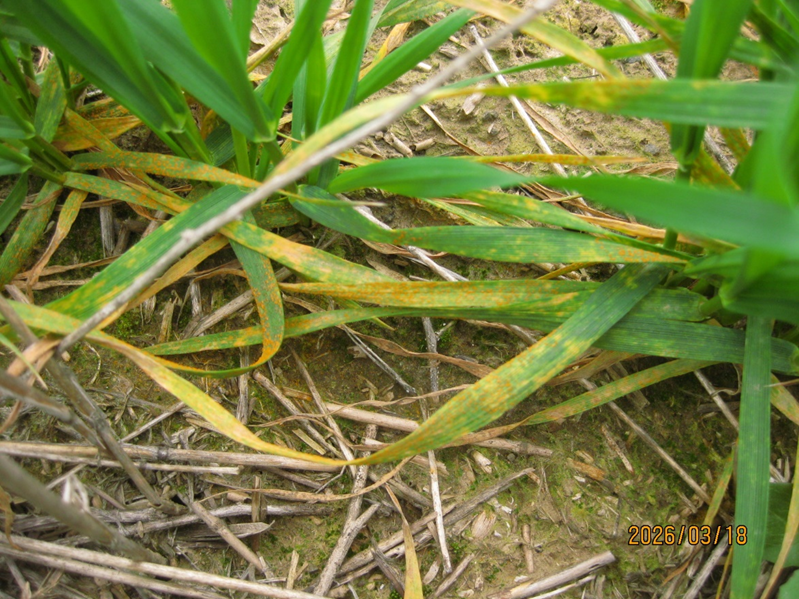
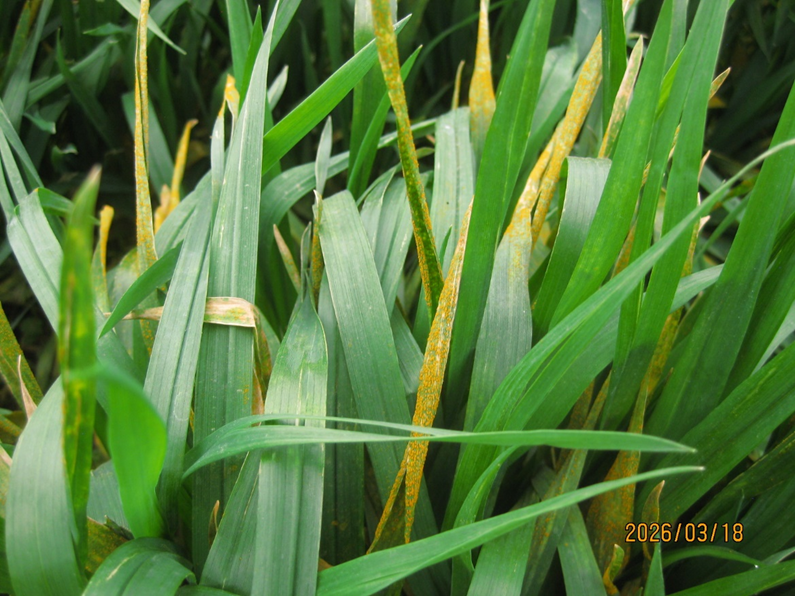
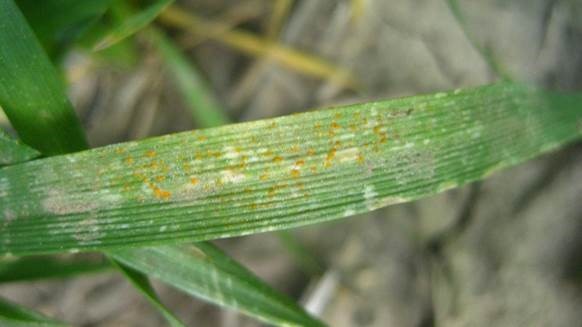
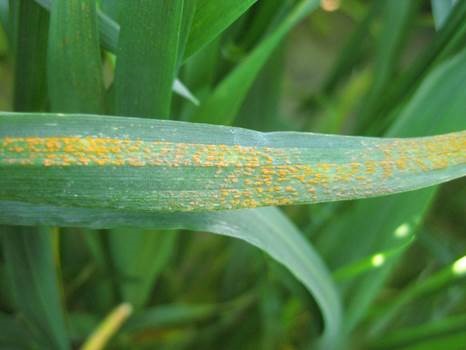
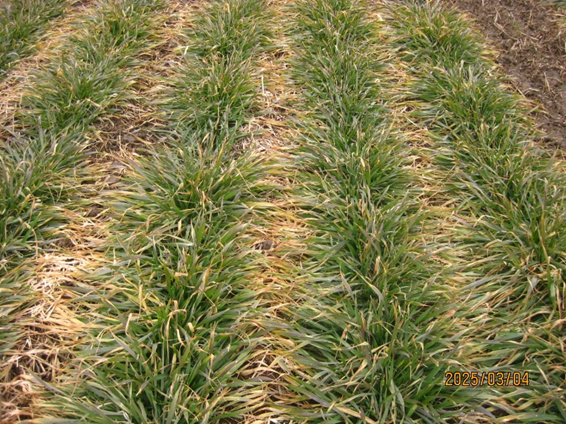
On March 18, we were checking wheat fields in Franklin, Benton, Walla Walla, Columbia, Garfield, and Whitman counties. Wheat plants ranged from Feekes 3 to 6. Stripe rust was found in all counties. In Franklin County, stripe rust has developed quickly since the field check on March 3, forming rust foci (hot spots) of several feet in diameter (Figure 1).
Figure 1. Stripe rust foci in a commercial wheat field in Franklin County, WA on March 18, 2026.


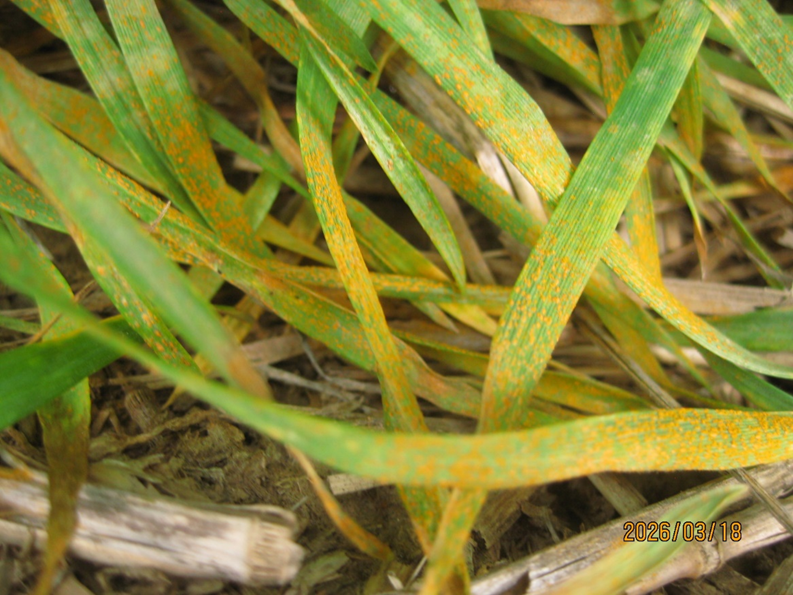
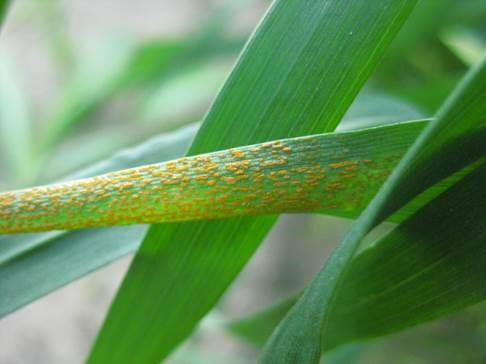
In Horse Heaven Hills (Benton County), rust incidence was much higher, reaching 40% incidence. Most of infections were still on low leaves but producing large quantity of rust spores (Figure 2).

Figure 2. Stripe rust fungus heavily infected low leaves of wheat plants and producing large quantity of spores in a commercial wheat field in Horse Heaven Hills (Benton County, WA) on March 18, 2026.


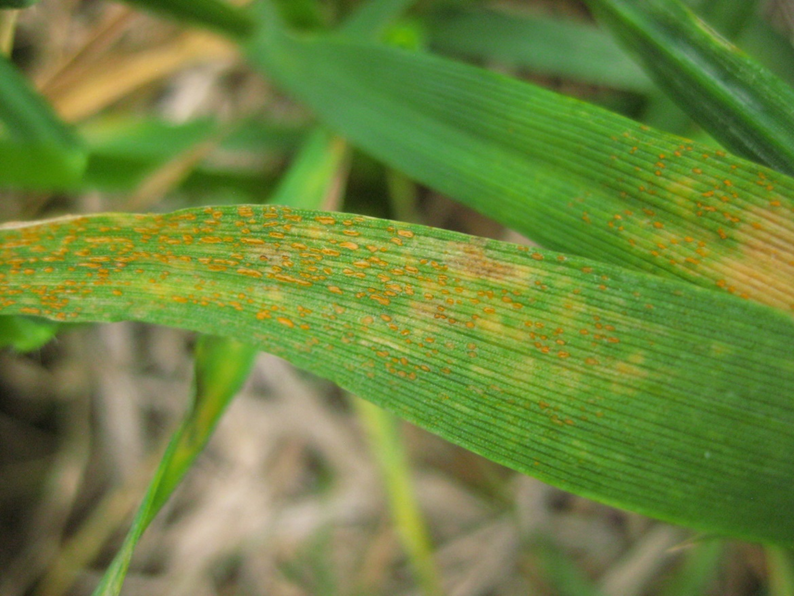
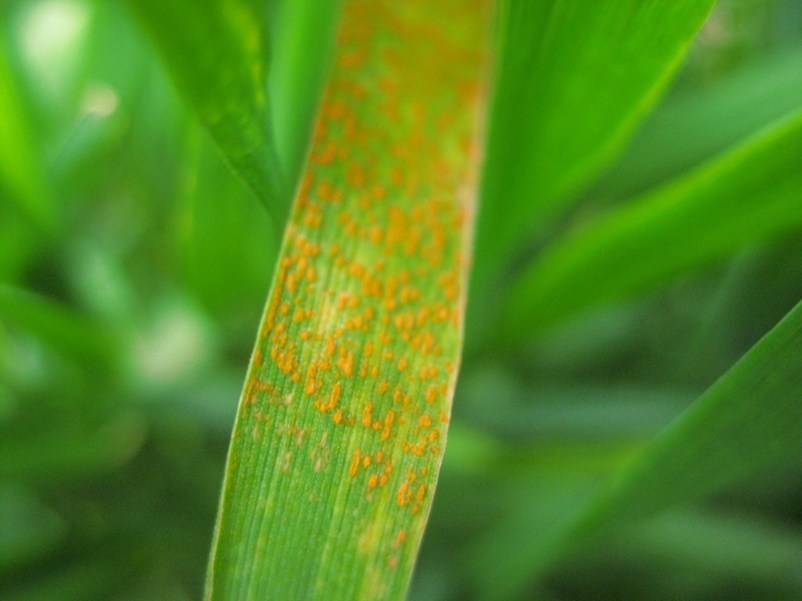
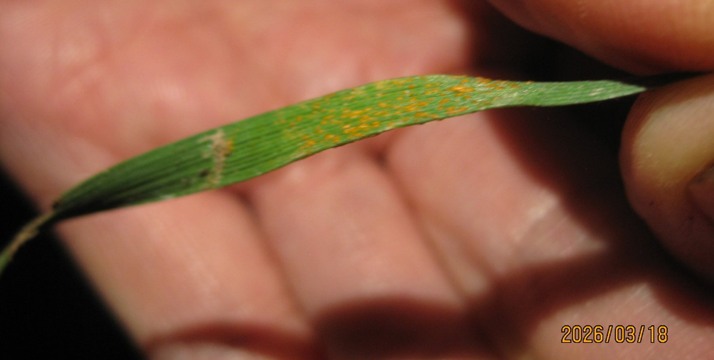
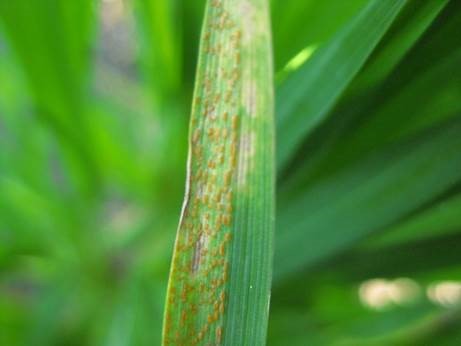
In Walla Walla, Columbia, and Garfield counties, stripe rust incidence and severity levels were much low in commercial fields (Figures 3 and 4) compared to Benton and Franklin counties, and almost all observed infections were on middle and top leaves, indicating recent infections. However, the disease was severe on susceptible varieties in our experimental field in Central Ferry (Garfield County), where wheat plants reached Feekes 6 and rust were over 90% incidence, 80% severity on low to middle leaves, and reached 40% incidence and severity on top leaves (Figure 5).

Figure 3. Stripe rust observed in a commercial wheat field in Walla Walla County, WA on March 13, 2026.
Figure 4. Stripe rust in an experimental wheat field in Columbia County, WA on March 18, 2026.
Figure 5. Stripe rust in an experimental wheat field in Central Ferry (Garfield County, WA) on March 18, 2026.


In Whitman County, stripe rust was first reported on cultivar ‘Nova AX’ in the Penawawa area in the southwest corner of the county on March 6 by Morgan Menaker, Regional Extension Agronomist, Washington State University. Yesterday, we found stripe rust in our experimental fields on the Palouse Conservation Field Station near Pullman (Figure 6). The rust incidence was low, and infections were on the first leaves, indicating that infections occurred before the winter. The observation of stripe rust at this location was about 5 weeks earlier than normal and 3 weeks later than the detection in 2011.

Figure 6. Stripe rust observed in an experimental field near Pullman (Whitman County, WA) on March 18, 2026
According to Dr. Ray Qin, stripe rust has been found in our stripe rust monitoring nursery at the Oregon State University Hermiston Agriculture Research and Extension Center (Umatilla County, OR).
Recommendations for control of stripe rust are the same as the previous. Please refer to “Stripe Rust Forecast and Update, March 4, 2026” (https://striperust.wsu.edu/2026/03/05/stripe-rust-forecast-and-update-march-4-2026/) for detail. Generally, please start checking your fields and use fungicides at the time of herbicide application, if you see rust.
 

 B. Stripe rust in the country

Since March 4, 2026, there have been no new states with reported stripe rust. So far, stripe rust has been reported in Washington, Oregon, California, and Texas.

Stripe Rust Forecast and Update, March 4 2026

Xianming Chen

A. Stripe rust is forecasted in the upper range of severe epidemics for the eastern Pacific Northwest

Wheat stripe rust is forecasted to be in the upper range of severe epidemic (40-60% yield losses on susceptible varieties) in the 2026 growing season for the eastern Pacific Northwest, based on the predication models using the weather data from November 2025 to February 2026. The models predict highly susceptible varieties to have 55.8% yield loss with a standard deviation of 6.2%. This value is like the 56.7% yield loss forecasted in January based only on the November-December weather data. According to these predictions, commercially grown varieties will likely have up to 40% yield losses, or 8% yield loss on average for commercially grown varieties without fungicide application.

B. Stripe rust is widespread, and the pathogen is actively producing spores in central Washington

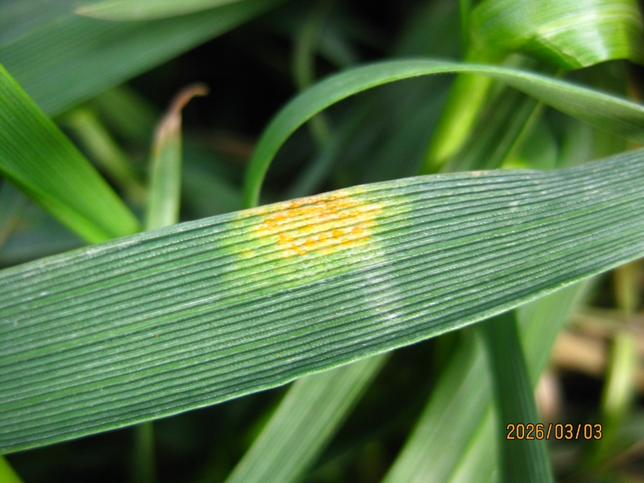
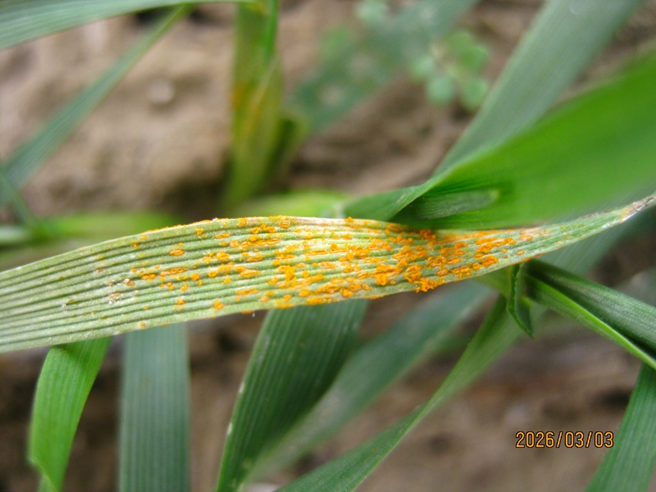
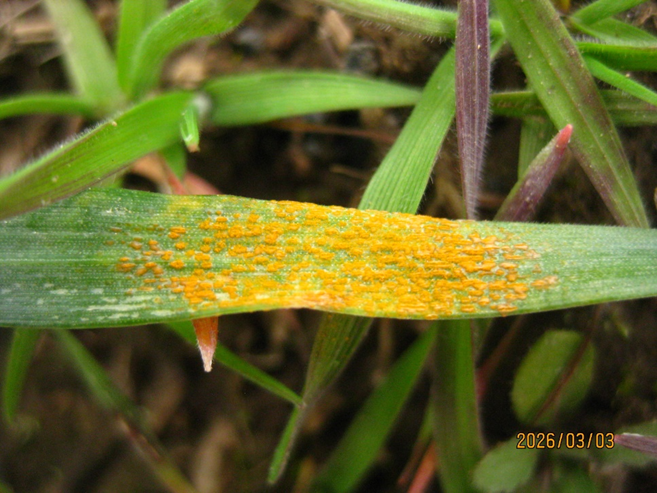
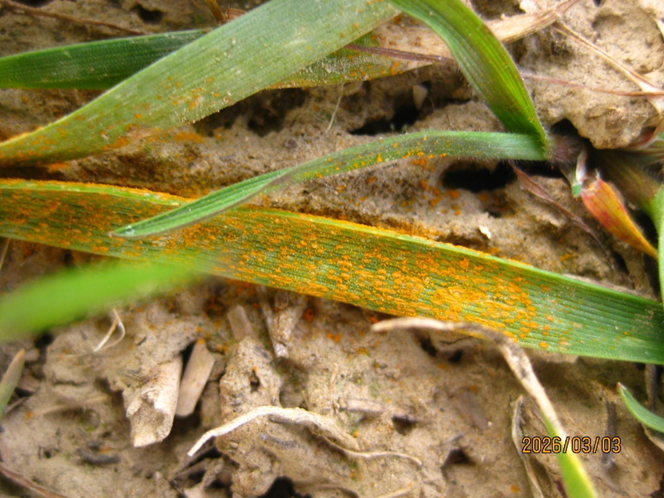
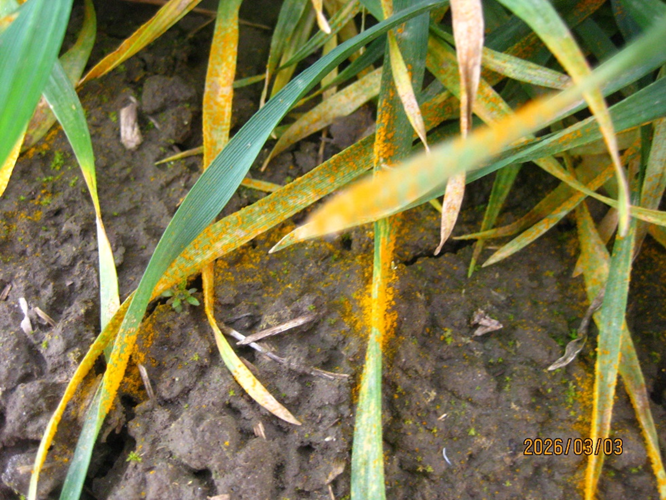
On March 3, we were checking winter wheat fields in Whitman, Lincoln, Adams, Franklin, and Walla Walla counties and found stripe rust in all these counties except Whitman (including our experimental fields near Pullman). Rust incidence and severity were more in the south than the north, correlating to the temperature patterns. In Lincoln County, we found stripe rust in 7 out of 10 commercial fields. Most of rust pustules were in the dormant stage with few active pustules (Figure 1). In the Adams and Franklin counties, active stripe rust pustules producing spores (Figure 2Figure 3) were found in every checked field (8 or 9 fields checked in each county). In our experimental field at the Lind station (Adams Co.), stripe rust reached 50% incidence (Figure 4). Stripe rust was more severe in our experimental field in Walla Walla, with incidence over 80% and rust reaching top leaves (Figure 5). This is the most widespread and severe stripe rust by this time of year in Washington since 2011.
Figure 1. Stripe rust observed in a commercial winter wheat field in Lincoln County, WA on March 3, 2026.
Figure 2. Stripe rust observed in a commercial winter wheat field in Adams County, WA on March 3, 2026.
Figure 3. Stripe rust observed in a commercial winter wheat field in Franklin County, WA on March 3, 2026.
Figure 4. Stripe rust in an experimental winter wheat field in Lind (Adams County, WA) on March 3, 2026.
Figure 5. Stripe rust in an experimental winter wheat field in Walla Walla (Walla Walla County, WA) on March 3, 2026.

C. Recommendations for managing stripe rust in the eastern Pacific Northwest

The field observations show the unusually early development of stripe rust, and the predictions indicate high potential yield losses in the 2026 wheat crop season for the eastern Pacific Northwest. Fungicide application is recommended for the winter wheat fields planted with moderately resistant to susceptible varieties with stripe rust ratings 3 to 9 at the time of herbicide application, and a second application may be needed 20 to 30 days after the first application, which can be determined by whether active stripe rust appears in the field after the first application. As many resistant varieties (stripe rust ratings 1 and 2) have only high-temperature adult-plant (HTAP) resistance, which will not be effective until the weather gets warm and plants reach the middle jointing stage (Feekes 7), stripe rust can develop on these varieties. Therefore, any wheat fields should be checked for stripe rust. If active rust like those shown in the figures above, fungicide should be applied at the timing of herbicide application. Refer to my previous report “2026 First Stripe Rust Forecast for the Eastern Pacific Northwest” for stripe rust ratings of wheat varieties (https://striperust.wsu.edu/2026/01/07/2026-first-stripe-rust-forecast-for-the-eastern-pacific-northwest/).
For spring wheat, resistant varieties (stripe rust ratings 1 or 2) should be selected for planting.  If for any reason varieties in the other categories (stripe rust ratings 3 to 9) are going to be planted, fungicide application will be likely needed at the time of herbicide application.
To select fungicides, please refer to the Appendix Table for information on active ingredients, application rate, control effect, effective duration, total limit per crop, and stage or date of application restriction.

 D. Stripe rust in the country

In 2026, stripe rust was first reported in central Washington on January 15, Pendleton, Oregon (Umatilla County), on January 27, Davis, California (Yolo County) on February 9, and the Hill and McLennan counties, Texas on January 12. The observations of stripe rust in the Davis area of California were also unusually earlier than normal. The occurrence of stripe rust in Texas in January is an indication of severe epidemic in the southern Great Plains and potentially epidemics in the central and northern parts of the Great Plains.
Appendix Table
Fungicides for control of stripe rust and other foliar diseases on cereal crops
Trade name Active ingredient(s) (%) Application rate (fl. oz/A) Control effecta Effective duration (days) Total limit per crop (fl. oz/A) Application restriction (no later than)
Absolute 500 SC Tebuconazole 22.6, Trifloxystrobin 22.6 5.0 – 7.7 VG 35 32 35 dbhb
Aframe Plus Azoxystrobin 13.5, Propiconazole 11.7 10.5 – 14 E 40 28 Feekes 10.5.4
Alto 100 SL Cyproconazole 8.9 3.0 – 5.5 VG 30 5.5 30 dbh
Aproach SC Picoxystrobin 22.5 6.0 – 12.0 VG 30 36 Feekes 10.5
Aproach Prima SC Cyproconazole 7.17, Picoxystrobin 17.94 3.4 – 6.8 E 40 6.8 45 dbh
Aprovia Ace Propiconazole 12.07, Benzovindiflupyr 7.24 9.45 E 40 18.9 Feekes 10.5.4
Avaris 2XS Propiconazole 11.7, Azoxystrobin 7.0 10.5 – 14.0 E 40 56 30 dbh
Bumper 41.8 EC Propiconazole 41.8 4 VG 30 8 Feekes 10.5
Caramba 0.75 SL Metconazole 8.6 10.0 – 17.0 E 40 34 30 dbh
Custodia Tebuconazole 18.3, Azoxystrobin 11.0 6.4 – 8.6 E 40 8.6 Feekes 10.5
Embrace Tebuconazole 38.7 4 4 30 dbh
Equation 2.08 SC Azoxystrobin 22.8 4.0 – 12.0 VG 30 24 Feekes 10.54
Evito 480 SC Fluoxastrobin 40.3 2.0 – 4.0 VG 20 8 Feekes 10.5 and 40 dbh
Fitness Propiconazole 41.8 4 VG 30 8 Feekes 10.5
Folicur 3.6 F Tebuconazole 38.7 4 E 30 4 30 dbh
Fortix Fluoxastrobin 14.84, Flutriafol 19.80 2-3 VG 30 12 Feekes 10.5
Headline SC Pyraclostrobin 23.6 9 VG 20 18 Feekes 10.5
Lucento Bixafen 15.55, Flutriafol 26.47 2-3 E 30 6 30 dbh
Miravis Ace Pydiflumetofen 13.7, Propiconazole 11.4 13.7 E 30 27.4 Feekes 10.5.4
Monsoon Tebuconazole 38.7 4 4 30 dbh
Muscle 3.6 F Tebuconazole 38.7 4 E 30 4 30 dbh
Nexicor EC Propiconazole 11.73, Fluxapyroxad 2.81, Pyraclostrobin 18.76 13 E 40 26 Feekes 10.5
Onset 3.6 L Tebuconazole 38.7 4 4 30 dbh
Orius 3.6 F Tebuconazole 38.7 4 4 30 dbh
Preemptor Fluoxastrobin 14.84, Flutriafol 19.30 2-3 G 20 12 Feekes 10.5
Priaxor 500 SC Fluxapyroxad 14.3, Pyraclostrobin 28.6 8 VG 30 16 Feekes 10.5
Proline 480 SC Prothioconazole 41.0 4.3 – 5.0 VG 30 9.37 30 dbh
Propiconazole E-AG 41.8 EC Propiconazole 41.8 4 8 Feekes 10.5
PropiMax 3.6 EC Propiconazole 41.8 4 8 Feekes 10.5
Prosaro 421 SC Prothioconazole 19.0, Tebuconazole 19.0 6.5 – 8.2 E 30 8.2 30 dbh
Quadris 2.08 SC Azoxystrobin 22.9 4.0 – 12.0 E 30 24 45 dbh
Quilt 200 SC Propiconazole 11.7, Azoxystrobin 7.0 10.5 – 14.0 E 40 28 Feekes 10.5
Quilt Xcel 2.2 SE Propiconazole 11.7, Azoxystrobin 13.5 10.5 – 14.0 E 40 28 Feekes 10.5
Stratego 250 EC Prothioconazole 11.4, Trifloxystrobin 11.4 10 VG 30 20 Feekes 10.5 and 35 dbh
Stratego YLD Prothioconazole 10.8, Trifloxystrobin 32.3 4 VG 30 8 Feekes 10.5 and 35 dbh
Tebucon 3.6 F Tebuconazole 38.7 4 4 30 dbh
Tebustar 3.6 F Tebuconazole 38.7 4 4 30 dbh
Tebuzol 3.6 F Tebuconazole 38.7 4 4 30 dbh
Tegrol Tebuconazole 38.7 4 4 30 dbh
Tilt 3.6 EC Propiconazole 41.8 4 VG 30 8 Feekes 10.5
Toledo 3.6 F Tebuconazole 38.7 4 4 30 dbh
Topguard Flutriafol 11.8 10.0 – 14.0 E 30 28 30 dbh
Topguard EQ Azoxystrobin 25.30, Flutriafol 18.63 3-4 E 30 9 30 dbh
Trivapro Benzovindifluryr 2.9, Azoxystrobin 10.5, Propiconazole 11.9 9.4 – 13.7 E 40 27.4 10.5.4
Twinline 1.75 EC Metconazole 7.4, Pyraclostrobin 12.0 7.0 – 9.0 E 40 18 Feekes 10.5
Vertisan Penthiopyrad 20.6 24 E 40 48 Feekes 10.5.1
Viathon 5.1 SC Tebuconazole 3.3, Potassium phosphite 49.0 2.0 pt E 30 16.5 30 dbh
Zolera FX Fluoxastrobin 17.76, Tetraconazole 17.76 3-5 VG 30 5 Feekes 10.5
a E = excellent, G = good, VG = very good, and – = no information from our tests.
b dbh = days before harvest.

2026 First Stripe Rust Forecast for the Eastern Pacific Northwest

Xianming Chen

Based on the weather data of November and December 2025, stripe rust in the 2026 wheat growing season is predicted to be in the topper range of severe epidemic level (40-60% yield loss on susceptible varieties). Using a set of forecast models based on the weather data of these two months, potential yield losses in 2026 caused by stripe rust on highly susceptible winter wheat varieties are predicted to be in the range of 35.3 to 78.2% with an average of 56.7%. The predicted severe epidemic level is attributed to the relatively warm weather so far. Based on the potential epidemic level, yield losses of commercially grown
varieties are predicted to be 0 to 40% depending upon the level of resistance or susceptibility of individual varieties. The next forecast will be made in early March based on the entire winter (November-February) weather data. According to the current forecast, fields planted with winter wheat varieties with stripe rust ratings 5 (moderate, M) to 9 (susceptible, S) may need early fungicide application at the time of
herbicide application. Resistant (ratings 1 and 2) and moderately resistant (ratings 3 and 4) spring wheat varieties should be selected to plant, and variety with MS and S ratings (6 – 9) should be avoided. See the tables (Table 1 and Table 2) below for stripe rust ratings of wheat varieties based on the tests in 2025

Table 1: 2025 stripe rust ratings of winter wheat varieties
Rating Varieties (Soft white (sw), Hard red (hr), Club (cl), CLOAX (CX), Hard White (hw)
R (1,2) AAC Vortex (hr), Allegiant 3412 (hr), aMaze (sw), AP Dynamic (sw), AP Exceed (sw), AP Iliad (sw), AP Octane (hr), AP Olympia (sw), Appleby CL+ (CX), ARS Castella (cl), ARS-Selbu 2.0 (sw), Bridger (hr), Bruehl (cl), Cameo (cl), Cara (cl, CS Bridger CLP (CX), Gale (sw), GS Bounty (sw), Inspire (sw), Jameson (sw), Jasper (sw), Kairos (hr), LCS Artdeco (sw), LCS Biancor (sw), LCS Blackjack (sw), LCS Drive (sw), LCS Evina (hr), LCS Hulk (sw), LCS Hydra AX (CX), LCS Jefe (sw), LCS Kamiak (sw), LCS Missile (hr), LCS Rocket (hr), LCS Scorpion AX (CX), LCS Shark (sw), LCS Shine (sw), LCS Sonic (sw), LCS Yetic (hw), LCS Zoom (hr), Mallory CL+ (CX), Milie (hw), Nimbus (sw), Nixon (sw), Norwest 553 (hr), Norwest Duet (sw), Norwest Tandem (sw), OR2x2 CL+ (CX), Pritchett (cl), Resilience CL}+ (CX), Rollie (sw), Rosalyn (sw), Sockeye CL+ (CX), Stephens (sw), Stingray CL+ (CX), SY Assure (sw), SY Banks (sw), SY Clearstone CL 2 (CX), SY Dayton (sw), SY Ovation (sw), SY Raptor (sw), TMCM-Pire (sw), TMCM-Press (sw), VI Bulldog (sw), VI Encore CL+ (CX), VI Frost (sw), VI Gem (sw), WB1529 (sw), WB1545 (sw), WB1604 (sw), WB1621 (sw), WB1922 (sw), WB4311 (hr), WB4510CLP (CX), WB4623CLP (CX), Windust (sw)
MR (3,4) Appleby CL+ (CX), AP Redeye (hr), AP Venom (hr), ARS Selbu (sw), Canvas (hr), Coda (cl), Curiosity CL+ (CX), Gemini (hr), HSG 108 (hr), Irv (hr), LCS Blackbird (hr), LCSE Eclipse AX (CX), LCS Ghost (sw), LCS Helix AX (CX), LCS Reaper II AX (CX), Mela CL+ (CX), Otto (sw), Sequoia (hr), UI Bronze Jade (hr), UI-WSU Huffman (sw), VI Presto CL+ (CX), WB1376CLP (CX), WB1720 (sw)
M (5) AP503 CL 2 (CX), ARS Crescent (cl), Guardian (hr), LCS Aymeric (hr), LCS Helix AX (CX), LCS Kraken AX (CX), Mary (sw), Piranha CL+ (CX), Punn (sw), Purl (sw), SY107 (sw), SY Command (sw), SY Touchstone (hr), UI Castle CL+ (CX), UI sparrow (sw), WB1783 (sw)
MS (6,7) AP700 CL (CX), AP Legacy (sw), Bobtail (sw), Canvas (hr), CPX66251 (sw), Debote (sw), Keldin (hr), LCS Fusion AX (CX), Milestone (hr), Scorpio (hr), UI Palouse CL+ (CX), VI Voodoo CL+ (CX), WB1532 (sw), WB4640 (hr)
S (8,9) Battle AX (CX), Brawl CL Plus (CX), CP7010 (hr), CP7909 (hr), Kivari AX (CX), LCS Dagger AX (CX), Snowmass 2.0 (hw), UI Magic CL+ (CX), WB4303 (hr), WB4394 (hr), WB Rimrock (hr), Whistler (hr), XF4303 (hr)


Table 2: 2025 stripe rust ratings of spring wheat varieties
Rating Varieties (Soft white (sw), Hard red (hr), Club (cl), CLOAX (CX), Hard White (hw)
R (1,2) Allegiant 6765 (hr), Alum (hr), AP Octane (hr), AP Renegade (hr), AP Venom (hr), Butch CL+ (CX), Chet (hr), CP3055 (hr), CP3066 (hr), CP3099A (hr), CP3119A (hr), CPX39120 (hr), Dayn (hw), Expresso (hr), Glee (hr), Hale (hr), Hedge CL+ (CX), JD (cl), Melba (cl), Net CL+ (CX), Roger (cl), Ryan (sw), Seahawk (sw), SY Basalt (hr), SY Gunsight (hr), SY Teton (hw), Tekoa (sw), TMC2021 (sw), TMC Lochaven (sw), UI Cookie (sw), UI Warrior (sw), WB6121 (sw), WB6211CLP (CX), WB7202CLP (hr), WB9636 (hr), WB9662 (hr),  WQL008 (sw), WQL195 (sw), YSC-605 (sw)
MR (3,4) Bush (sw), Cabernet (hr), CP3322 (hr), Diva (sw), HSG Timberline (hr), Kelse (hr), LCS Hammer AX (CX), LCS Iron (hr), Louise (sw), MT Carlson (hr), SY Coho (hr), SY Selway (hr), SY Steelhead (hr), UI Gold (hw), UI Platinum (hw), UI Stone (sw), SY Saltese (sw), WB9668 (hr), YSC-603 (sw)
M (5) AP Coachman (sw), Buck Pronto (hr), Bullseye (hr), Jefferson (hr), WB6341 (sw), Whit (sw)
MS (6,7) AP Mondovi CL2 (sw), CP3915 (hr), Hollis (hr), Jefferson HF (hr), LCS Luna (hr), WB9303 (hr)
S (8,9) Allegiant 6633 (hr), Babe (sw), CP3530 (hr), SY605 CL2 (hr), MT Dutton (hr), MT Ubet (hr), WB1035 CL+ (CX)

Stripe Rust Update and Special Notes on Yr5 and Yr15, June 18, 2025

Xianming Chen

Stripe rust in the Pacific Northwest

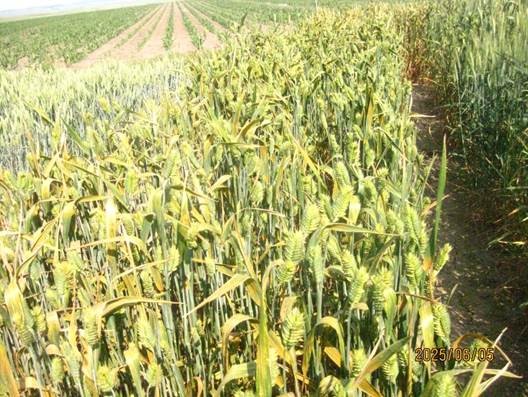
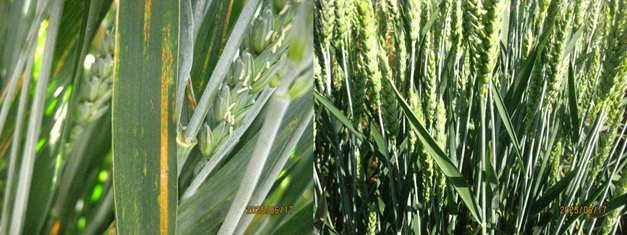
So far, we have completed recording stripe rust data of our winter crop nurseries in various locations including Central Ferry, Mount Vernon, Wallla Walla, Lind, and Pullman (Palouse Conservation Field Station, Plant Path Farm, and Spillman Farm), Washington and Hermiston, Oregon. Wheat stripe rust developed to 90-100% severities on susceptible varieties in all locations (Figures 1 and 2), except the Spillman Farm site that apparently has shallow soil and stripe rust developed only up to 60% severity on the susceptible check. We have not noticed obvious differences in stripe rust reactions among popular varieties except ‘Bobtail’, which had distinct reactions in different nurseries even at the same locations (Figures 3). This variety caught our attention as we first noticed rust (infection type 5 and severity 50%) on it in the WSU Winter Wheat Variety Trial nursery when we took the first-time note in April and saw rust (infection type 5 and severity 20%) on the same entry at Central Ferry in May. The variety in the same nursery had infection type 8 and severity 20% at the Palouse Conservation Field Station, near Pullman. However, the Bobtail entries in our regional winter wheat variety nursery and the Oregon Wheat Breeding nursery at the same location did not have rust. A few years ago, Dr. Chris Mundt noticed stripe rust on Bobtail in Corvallis, Oregon and in that year, Bobtail was rust free in the experimental fields around Pullman. Based on this year’s observations, Bobtail may have two different sources of seeds, one is still highly resistant to stripe rust while the other is or has become moderately susceptible. From next year and forward, growers need to pay attention to stripe rust if planting this variety.

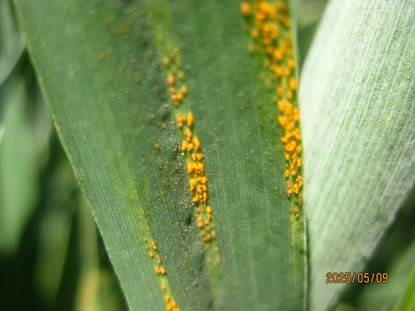
Figure 1. Stripe rust in an experimental field in Walla Walla, Washington on June 5, 2025.
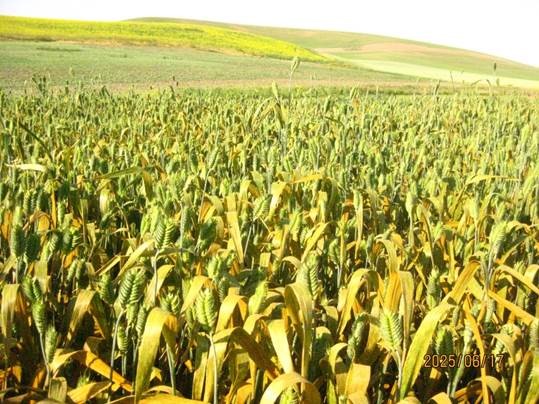
Figure 2. Stripe rust in an experimental field at the Palouse Conservation Field Station near Pullman, Washington on June 17, 2025.
Figure 3. Stripe rust on Bobtail in the WSU Winter Wheat Variety Trial nursery (left) and no rust on Bobtail in the Oregon Wheat Breeding Program nursery in an experimental field at the Palouse Conservation Field Station near Pullman, Washington on June 17, 2025.


Barley stripe rust developed up to 80% severity on susceptible winter varieties in our experimental fields in Central Ferry, Mount Vernon, Walla Walla, and the Plant Pathology Farm (inoculated) near Pullman, Washington.

In commercial fields, stripe rust was found in some fields of both winter and spring wheat in Adams, Walla Walla, and Whitman Counties and mostly below 1% severity. The stripe rust season is generally over for winter wheat, and the disease currently has low potential to cause damage to spring wheat as the weather has been dry. Fungicide application is not recommended except for fields planted with susceptible or moderately susceptible varieties under irrigation or in areas with high moisture.

Stripe rust in the country

Since the last update (May 21), stripe rust has been reported in Michigan, Nebraska, Idaho, and Virginia). So far, twelve states (Louisiana, Texas, Georgia, Washington, Oregon, California, Oklahoma, Kansas, Michigan, Nebraska, Idaho, and Virginia) have been reported to have stripe rust.

Special notes on Yr5 and Yr15 resistance

Yr5 and Yr15 are among few wheat genes that confer effective all-stage resistance against the stripe rust pathogen populations in the world. These two genes have been used quite intensively in breeding programs within the last two decades or so. The stripe rust isolates virulent to Yr5 have been reported in Australia and India many years ago and in China and Turkey in the recent years, but the virulent isolates have not spread even in these countries. Similarly, virulence to Yr15 was also reported in a couple of countries many years ago but has not caused much concern until this year. In this spring, stripe rust was first found on wheat varieties carrying Yr15 in the United Kingdom and later found in several European countries including Denmark. Apparently, the rust has caused damage in commercial fields grown with wheat varieties carrying Yr15. This is an alarm to the world.

In the United States, we have not found any stripe rust isolates with virulence to either Yr5 or Yr15. Starting in 2010, we have included Yr5 and Yr15 into our set of wheat lines used to identify races of the wheat stripe rust pathogen so that every wheat stripe rust sample has been tested on these lines. In addition to every year’s tests of stripe rust samples since 2010, we have also tested stripe rust collections from 1968 to 2009. All stripe rust isolates we have tested so far are not virulent to either of the genes.

Starting using Yr5 and Yr15 in wheat breeding programs in the United States, the wheat research community has been calling for and setting up a stewardship of developing new varieties with these two genes in combination rather than just one of them to extend their lifetime of effectiveness. So far, about 15 to 20 wheat varieties, mostly of spring wheat, with the two genes together are commercially grown. Examples are Seahawk grown in the Pacific Northwest and Patwin 515 in California. About 80% of California wheat acreage is currently grown with various “515” varieties (carrying both Yr5 and Yr15). To my knowledge, only spring wheat variety ‘Expresso’ has Yr15 but no Yr5. As Expresso was developed from Express by adding Yr15 and Yr17 (not effective against the predominant races), it also should have the high-temperature adult-plant (HTAP) resistance genes from Express and the Yr17 donor (Yr17 is linked to a HTAP resistance gene). Because of the combination of Yr5 and Yr15 in the US wheat varieties, the Yr15 race from Europe or the Yr5 race from Asia will not be an immediate threat to the US varieties with these genes even the races spread to the US. However, virulent mutants may arise from the rust population within the country and the pathogen is able to combine different virulent genes. We all need to pay attention to rust in the fields. When you see stripe rust on previously resistant varieties or just like to know if stripe rust on any varieties is the same or different from the past, please collect and send leaf samples with stripe rust to us (Xianming Chen, USDA, WSU, 410 SE Dairy Rd, 114B – 101, Pullman, WA 99164) for virulence testing and race identification.

Stripe Rust Update, May 21, 2025

Xianming Chen

Stripe rust has been developing in Washington

Since the last stripe rust update on May 7, stripe rust has been developing in the Pacific Northwest (PNW), especially in Washington. After the update, we received a report of stripe rust in commercial fields of winter wheat in Franklin County, Washington. On May 9, we checked the fields planted with Piranha CL+ and Nova AX, and stripe rust was easy to find (Figure 1) although the incidence was less than 1%. The Nova AX field was sprayed with fungicides a day before and the Piranha field was sprayed on that day. We checked more than ten additional commercial fields of winter wheat fields in Franklin and Adams counties and found stripe rust in three fields with incidence less than 0.1%.

Figure 1: Stripe rust in a commercial field planted with winter wheat variety Piranha CL+ in Franklin County, Washington on May 9, 2025.


On May 15, we were checking our experimental fields around Pullman, Washington (Whitman County). Stripe rust was easier to find than a week earlier on spreader rows planted with a highly susceptible winter wheat variety, but still below 1% incidence. No rust was found in commercial winter wheat fields in the Palouse region.

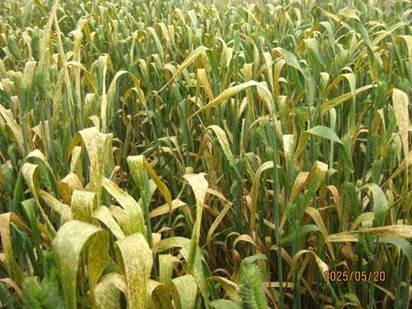
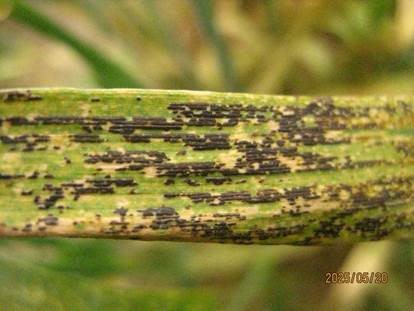
On May 20, we were taking stripe rust data in our winter germplasm screening nurseries at the Central Ferry station (Garfield County), Washington. Winter wheat reached the flowering stage (Feekes 10.51-10.53) and barley reached Feekes 10.53-10.54. As expected, stripe rust reached 90 to 100% severity on susceptible varieties of both wheat and barley (Figure 2). The stripe rust fungus turned into the black telial stage (Figure 3), which no longer produces infectious, orange-colored spores. Some strains of the stripe rust fungus turn into the telial stage faster than others.

This picture shows a field that is very infected with stripe rust. The leaves are mostly orange
Figure 2: Stripe rust in an experimental field in Central Ferry (Garfield County), Washington on May 20, 2025.
Figure 2: Stripe rust black telial pustules on a susceptible winter wheat variety in an experimental field in Central Ferry (Garfield County), Washington on May 20, 2025


Stripe rust in the country

Since the last update (May 7), stripe rust has not been reported in any additional states. Thus, only eight states, Louisiana, Texas, Georgia, Washington, Oregon, California, Oklahoma, and Kansas, have been reported to have stripe rust so far. Even in these states, stripe rust has appeared at relatively low levels compared to last year, except California. However, stripe rust may still have time and conditions to develop to epidemic levels in some regions.

Table 1. Stripe rust infection types (IT) and severity (%) on entries of the WSU 2025 winter wheat variety trials recorded so far from Mount Vernon and Central Ferry, Washington.
Sequence
of
Class
VT
Name
2025
PLOT
Mount Vernon Central Ferry Sequence
of
Class
VT
Name
2025
PLOT
Mount Vernon Central Ferry
4/15/2025 5/20/2025 4/15/2025 5/20/2025
Feekes 5 Feekes 10.54 Feekes 5 Feekes 10.54
IT* % IT* % IT* % IT* %
1 AAC Vortex 1 2 20 3 5 26 LWW22-6372 64 2 20 2 2
2 Bridger 2 2 20 2 5 27 LWW22-6387 65 5 40 2 2
3 CO19D087R 3 2 15 3 5 28 LWWA22-S22 AX 66 2 20 2 2
4 CP7909 4 2 20 8 20 29 Nimbus 67 2 10 2 2
5 CS Bridger CLP 5 3 30 2 5 30 Norwest Tandem 68 2 20 2 2
6 GHR22-3 6 3 30 2 2 31 OR2170559 69 2 10 3 5
7 GSHR5 7 3 30 2 2 32 OR2180149 70 2 20 3 20
8 HSG 086 8 2 20 3 5 33 OR2180350 71 2 20 3 10
9 HSG 124 9 3 30 2 2 34 OR2190671 72 2 30 2 5
10 Irv 10 2 20 2 2 35 OR2200130 73 2 20 2 2
11 Kairos 11 2 10 2 2 36 OR5180071 74 2 10 2 10
12 Kivari AX 12 5 50 8 10 37 OR5180072 75 2 20 2 5
13 LCS Blackbird 13 2 10 2 2 38 OR5190014 76 2 20 2 10
14 LCS Eclipse AX 14 2 10 2 2 39 OR5210096 77 2 20 2 2
15 LCS Missile 15 2 10 2 2 40 PN18MS604566 78 5 60 3 20
16 LWH20-0490 16 3 30 2 2 41 Rosalyn 79 5 40 2 2
17 LWH21-0760 17 2 20 2 2 42 TMC M-Pire 80 2 30 2 2
18 LWH21-5237 18 2 15 2 2 CHK PS279 (S. check) 81 9 70 9 100
19 LWH22-0087 19 2 20 2,8 2,10 43 TMC M-Press 82 2 20 2 2
20 LWH22-1003 20 2 15 2 2 44 VI Gem 83 2 20 2 2
CHK PS279 (S. check) 21 9 70 9 95 45 WA8426 84 2 10 2 2
21 LWH22-5463 22 2 10 2 2 46 WA8438 85 2 20 3 5
22 Millie 23 2 10 2 2 47 WA8439 86 2 15 2 2
23 OR2190064R 24 2 20 2 5 48 WA8441 87 2 20 2 2
24 OR2190160R 25 2 15 2 2 49 WA8442 88 2 10 2 10
25 OR2190165R 26 2 10 2 2 50 WA8447 89 5 30 3 10
26 OR3230008H 27 2 10 2 2 51 WA8448 90 3 30 2,8 2,80
27 OR3230010H AX 28 2 10 8 5 52 WA8451 MZ 91 2 30 3 20
28 OR3230015H AX 29 2 10 2 2 53 WB1621 92 2 10 3 15
29 WA8368 30 2 20 8 10 54 WB1720 93 3 30 2 2
30 WA8424 31 2 15 2 2 55 WB1922 94 3 40 2 5
31 WA8425 32 2 10 2 2 56 XH1046 95 2 10 8 30
32 WA8449 33 2 20 2 2 57 WFX69113 96 5 60 5 50
33 WB4303 34 2 20 8 30 58 WFX69333 97 2 30 3 15
34 WB4510CLP 35 2 20 2 2 59 XG1305 98 2 10 7 30
35 WB4640 36 2 30 5 30 1 Appleby CL+ 99 2 20 2 15
1 14-211120A 37 2 15 2 2 2 Curiosity CL+ 100 3 30 5 40
2 16-007057A 38 2 20 2 2 CHK PS279 (S. check) 101 9 70 9 100
3 16-478001 39 2 15 2 2 3 LCS Dagger AX 102 3 30 8 70
4 17-355144A 40 2 20 2 2 4 LCS Hydra AX 103 2 10 2 10
CHK PS279 (S. check) 41 9 70 9 95 5 LCS Reaper II AX 104 3 20 2,8 2,80
5 17-995133B 42 2 20 2 2 6 LCS Scorpion AX 105 2 20 2 2
6 AP Iliad 43 2 15 2 2 7 LWHA21-5188 AX 106 2 20 3 15
7 AP Olympia 44 2 10 2 2 8 LWHA22-0008 AX 107 2 20 3 15
8 ARS Crescent 45 3 20 2 2 9 LWWA22-H22 AX 108 2 20 3 30
9 Bobtail 46 5 50 5 20 10 LWWA22-S22 AX 109 2 15 2 2
10 Gale (OR2180377) 47 2 20 2 2 11 LWWC21-0317 CL+ 110 2 10 3 20
11 GS Bounty 48 2 20 5 10 12 LWWC21-5070 CL+ 111 2 30 5 40
12 GSW22-21 49 2 20 7 30 13 Mallory CL+ 112 2 20 2 2
13 LCS Artdeco 50 3 30 3 10 14 OR2200083 CL+ 113 2 30 2 2
14 LCS Blackjack 51 2 20 2 2 15 OR3230013 AX 114 2 20 2 5
15 LWW20-2383 52 2 10 2 2 16 OR3230026 AX 115 2 20 2 2
16 LWW20-2867 53 2 10 2 2 17 Resilience CL+ 116 2 10 2 2
17 LWW20-3371 54 2 15 2 2 18 UIL 19-713070A CL+ 117 2 20 2 2
18 LWW21-1436 55 2 20 2 2 19 VI Encore CL+ 118 2 20 2 2
19 LWW21-1554 56 2 10 2 2 20 VI Presto CL+ 119 2 20 2,8 2,20
20 LWW22-0837 57 2 30 2 2 21 WA8443 AX 120 5 40 3 10
21 LWW22-1105 58 2 20 2 2 CHK PS279 (S.check) 121 9 70 9 95
22 LWW22-1232 59 3 30 2 2 22 WA8444 AX 122 2 10 8 20
23 LWW22-2425 60 3 30 2 2 23 WA8445 CL+ 123 2 15 2 2
CHK PS279 (S. check) 61 9 70 9 95 24 WA8446 CL+ 124 2 15 2 2
24 LWW22-2864 62 3 30 2 2 CHK PS279 (S. check) 125 9 70 9 95
25 LWW22-4020 63 2 10 2 2 CHK PS279 (S. check) 126 9 70 9 95
* IT = infection type.  ITs 0-3 are considered resistant (R), 4-5 moderately resistant (MR), 6-7 moderately susceptible (MS), and 8-9 susceptible.


Stripe Rust Update, May 7, 2025

Xianming Chen

Stripe rust is appearing in the Palouse region

Yesterday, we were checking fields around Pullman, Washington (Whitman County). Winter wheat and barley arranged from Feekes 5 to 7. We were able to find stripe rust on susceptible checks in all our experimental fields at the Palouse Conservation Field Station, Plant Path Farm, and Spillman Farm. The incidence was low (<0.01%) in all locations, as the rust just started producing spores (Figure 1).

Figure 1: Stripe rust on a winter wheat leaf in an experimental field in Pullman, Washington on May 6, 2025


The observations of stripe rust in these locations are about one month later than that of last year, but about the normal time to see stripe rust in the Palouse region. With the weather conditions in the recent weeks have been favorable and those of the next couple of weeks forecast to be favorable to stripe rust, the disease would be developed to a significant level. Based on the current stripe rust situation and prediction, our recommendations are the same as we issued in the last stripe rust update (April 18). Fungicide applications are recommended for winter wheat fields planted with susceptible and moderately susceptible varieties (stripe rust ratings 6 to 9) before flowering. For spring wheat, please consider fungicide application at the time of herbicide application for the fields planted with susceptible (stripe rust ratings 8 and 9) or moderately susceptible (stripe rust ratings 6 and 7) varieties. It is always recommended to check your fields. If you see active rust like the above picture or rust incidence (percentage of leaves with rust) reaches 5%, you should apply a fungicide labeled for stripe rust as soon as possible.

Stripe rust in the country

So far, stripe rust has been reported in Louisiana, Texas, Georgia, Washington, Oregon, California, Oklahoma, and Kansas. Compared to last year, stripe rust has been relatively low in the Great Plains and southeastern region. However, growers should check their wheat or barley fields for signs of stripe rust and apply fungicides when needed, following recommendations in their region.

Stripe Rust Update, April 18, 2025

Xianming Chen

Stripe rust is developing in the Pacific Northwest


In the last two weeks, we were planting spring cereal nurseries and checking winter wheat fields in various locations. So far, we have found stripe rust in our disease monitoring and germplasm screening fields in various locations except those around Pullman.


On April 9, our crew found stripe rust in our winter crop nursery at Walla Walla (Walla Walla County), Washington, and we re-checked the field on April 17. The crop reached Freekes 6-7. Stripe rust was easy to find in the border rows planted with the susceptible check, and the rust incidence reached 5% (Figure 1). Compared to this time of last year, stripe rust has not reached the last year’s severity level at this location. We checked some commercial fields in the area, but did not find rust. On April 14, our crew also found stripe rust in our winter crop nursery at Lind (Adams County, Washington), and the incidence was higher than the same time of last year.

This plant is experiencing stripe rust level of 8 where it does not show any necrosis around the rust spores
Stripe rust on winter wheat plants in an experimental field in Walla Walla, Washington on April 17.

On April 15, we were checking the winter wheat field in Lincoln County, Washington, where we found stripe rust last November, but did not find rust.


On April 15 and 16, we were collecting stripe rust data on winter nurseries in Mount Vernon, Skagit County, Washington, stripe rust reached to 70% severity on susceptible entries, as severe as usual for this location in western Washington.


On April 17, we were checking our winter wheat monitoring nursery in Hermiston, Umatilla County, Oregon and found stripe rust (Figure 2). The rust just started.

Wheat leaf with sever rust infection
Stripe rust on winter wheat in an experimental field in Hermiston, Umatilla County, Washington on April 17, 2025.

On April 17, we found stripe rust in our winter crop nurseries in Central Ferry, Garfield County, Washington. Winter wheat reached Feekes 7-8 and barley to Feekes 10. Stripe rust was easy to find on susceptible checks (Figure 3), and the incidence and severity were higher than those of last year at this location.

Wheat leaf with streaking lines of stripe rust
Stripe rust an experimental field in Central Ferry, Garfield County, Washington on April 17, 2025.

On April 17, we were checking our winter wheat nurseries at the Palouse Conservation Field Station near Pullman (Whitman County), Washington and did not see any rust. Lat year, stripe rust was easy to see in the first week of April. For the Palouse region, stripe rust normally starts in the first week of May.


In the eastern Pacific Northwest, stripe rust started relatively late compared to last year, but the disease can develop to an epidemic considering the high moisture so far and favorable forecast weather (both temperature and precipitation) in the next several weeks. Based on the current stripe rust situation and the new prediction, our recommendations are changed from those issued in early March. Fungicide applications are recommended for winter wheat fields planted with susceptible and moderately susceptible varieties (stripe rust ratings 6 to 9) before flowering. For spring wheat, if you have not planted, please choose resistant or moderately resistant varieties (stripe rust ratings 1 – 4). For fields planted with susceptible (stripe rust rating 8 and 9) or moderately susceptible (stripe rust ratings 6 and 7) varieties, please consider fungicide application at the time of herbicide application. It is always recommended to check your fields. If you see active rust or rust incidence or severity reaches 5%, apply fungicides as soon as possible.


Stripe rust in the country


So far, stripe rust has been reported in Louisiana, Texas, Georgia, Washington, and Oregon. Compared to last year, stripe rust has been relatively low countrywide, but the disease can develop quickly under favorable weather conditions. Growers should check their wheat fields for signs of stripe rust and apply fungicides when needed, following recommendations in your region.

Stripe Rust Forecast, March 5, 2025

Xianming Chen

Stripe rust is forecasted in the low epidemic range for the eastern Pacific Northwest

Wheat stripe rust is forecasted to be in the low epidemic range (1-20% yield loss) for the 2025 growing season for the eastern Pacific Northwest, based on the predication models using the weather data from November 2024 to February 2025. The models predicted highly susceptible varieties to have 18% yield loss with a standard deviation of 9%. This value is much lower than the 41% forecasted in January based only on the November-December weather data. The reduced predicted yield loss was due to the cold weather in February. According to the current prediction, commercially grown varieties with moderate (5), moderately susceptible (6, 7), and susceptible (8, 9) stripe rust ratings will likely have 2 to 13% yield losses, or 2.4% yield loss on average for all recently grown winter wheat varieties without fungicide application. For comparison, the last March forecast was 51% yield loss for highly susceptible varieties, and the susceptible check had 56% yield loss in the winter wheat experimental field in 2024.


Stripe rust has survived the winter well in central Washington

On March 4, my colleague and I were checking wheat fields in Whitman, Adams, Lincoln, Franklin, and Walla Walla counties. Wheat plants were generally in good conditions without obvious winter injure. No stripe rust was observed in any of the checked fields, including the commercial wheat field east of Almira along Highway 2 in Lincoln County (Figure 1), the same field where we found stripe rust on November 5, 2024.  In the last year, stripe rust was found in several fields by the end of February.

Recommendations for the eastern Pacific Northwest

Based on the currently predicted low level of potential damage by stripe rust for the eastern Pacific Northwest, fungicide application is not recommended for winter wheat fields unless the disease is observed during the crop season. For spring wheat and barley, resistant and moderately resistant varieties are recommended to plant.


Stripe rust in the country

So far, stripe rust has not been reported anywhere in the country. By this time of the last year, stripe rust was reported in Louisiana, Texas, and Washington.

Image showing winter wheat plants without stripe rustFigure 1. Wheat plants without stripe rust in a field in Lincoln County, WA on March 4, 2025, the same field in which we found stripe rust on November 5, 2024.

2025 First Stripe Rust Forecast for the Eastern Pacific Northwest

January 7, 2025
Xianming Chen

Based on the weather data of the November and December 2024, stripe rust in the 2024 wheat growing season is predicted to be in the range of severe epidemic level (40-60% yield loss on susceptible varieties). Using a set of forecast models based on this winter weather data so far (November and December 2024), highly susceptible winter wheat varieties are predicted to have potential yield losses in the range of 27 to 57% with an average of 41% caused by stripe rust in 2025. The predicted severe epidemic level is attributed to the relatively warm weather in these two months. Based on the potential epidemic level, commercially grown varieties are predicted to have 0 to 29% yield losses depending upon the level of resistance or susceptibility of individual varieties. The next forecast will be made in early March based on the entire winter weather data. According to the current forecast, fields grown with moderately susceptible (MS, ratings 6 and 7) or susceptible (S, ratings 8 and 9) winter wheat varieties may need the early fungicide application at the time of herbicide application. Resistant (ratings 1 and 2) and moderately resistant (ratings 3 and 4) spring wheat varieties should be selected to plant, and variety with MS and S ratings (6 – 9) should be avoided. See the tables (Table 1 and Table 2) below for stripe rust ratings of wheat varieties based on the tests in 2024.

Table 1Stripe rust ratings of winter wheat varieties
Rating Varieties
Soft White Hard Red Club Hard White
R (1,2) aMaze, AP Dynamic, AP Exceed, AP Iliad, AP Olympia, ARS-Selbu 2.0, Bobtail, Inspire, Jameson, Jasper, LCS Biancor, LCS Blackjack, LCS Drive, LCS Hulk, LCS Jefe, LCS Kamiak, LCS Scorpion AX, LCS Shark, LCS Shine, LCS Sonic, Nimbus, Nixon, Norwest Duet, Norwest Tandem, OR2x2 CL+, Resilience CL+, Rollie, Rosalyn, Sockey CL+, Stingray CL+, SY Assure, SY Banks, SY Dayton, SY Ovation, SY Raptor, TMC M-Press, VI Bulldog, VI Frost, VI Presto CL+, WB1529, WB1545, WB1604, WB1621, WB1922, Windust Allegiant 3412, AP Octane, LCS Evina, LCS Missile, LCS Rocket, LCS Zoom, Norwest 553, SY Clearstone CL2, WB4311, WB4510CLP, WB4623CLP ARS Castella, Bruehl, Cameo, Cara, Pritchett LCS Yeti
MR (3,4) ARS Selbu, LCS Artdeco, LCS Ghost, LCS Hydra AX, LCS Reaper AX, Mela CL+, Otto, UI-WSU Huffman, WB1376CLP, WB1720 Appleby CL+, AP Redeye, AP Venom, Canvas, LCS Helix AX, UI Bronze Jade, Gemini, HSG 108, Kairos, LCS Eclipse AX, Sequoia Coda Millie
M (5) GS Bounty, LCS Kraken AX, Mary, Piranha CL+, Puma, Purl, SY107, SY Comman, UI Castle CL+, UI Sparrow, WB1783 AP503 CL2, Guardian, LCS Aymeric, LCS Blackbir, LCS Helix AX, SY Touchstone
MS (6,7) AP700 CL, AP Legacy, CPX66251, Curiosity CL+, Devote, Irv, TMC M-Pire, UI Palouse CL+, WB1532 Canvas, Keldin, LCS Fusion AX, Milestone, Scorpio ARS Crescent
S (8,9) LCS Dagger AX, UI Magic CL+, VI Voodoo CL+ Battle AX, Brawl CL Plus, CP7010, CP7909, Kivari AX, WB4303, WB4394, WB Rimrock, Whistler, XF4303


Table 2: Stripe rust ratings of spring wheat varieties
Rating Varieties
Soft White Hard Red Club Hard White
R (1,2) Butch CL+, Seahawk, TMC2021, UI Cookiem WB6121, WQL008, WQL195, YSC-605 Allegiant 6765, Alum, AP Octane, AP Renegade, AP Venom, CP3055, CP3066, CP3099A, CP3119A, CPX39120, Expresso, Glee, Hale, SY Basalt, SY Gunsight, WB7202CLP, WB9636, WB9662 Hedge CL+, JD, Melba, Roger Dayn, SY Teton
MR (3,4) Diva, Ryan, Tekoa, TMC Lochaven, UI Stone, SY Saltese, WB6211CLP, YSC-603 Cabernet, Chet, CP3322, LCS Iron, Net CL+, SY Coho, SY Selway, SY Steelhead, WB9668 UI Platinum
M (5) AP Coachman, Louise, WB6341, Whit Buck Pronto, Bullseye, Jefferson, LCS Hammer AX
MS (6,7) AP Mondovi CL2 CP3915, Hollis, Jefferson HF, LCS Luna, Kelse, WB9303
S (8,9) Babe, WB1035 CL+ Allegiant 6633, CP3530, SY605 CL2, MT Carlson, MT Dutton

Stripe Rust Update, November 18, 2024

2024 Wheat Variety Yield Loss and Fungicide Tests and Stripe Rust Survey in November

November 18, 2024
Xianming Chen

A. Yield losses caused by stripe rust and increases by fungicide application on wheat varieties tested in 2024


The experiment for assessing yield losses caused by stripe rust on 23 major winter wheat varieties grown in the Pacific Northwest (PNW), in comparison to susceptible check ‘PS279’, was conducted on the Palouse Conservation Farm Station (PCFS), near Pullman, WA in a randomized split-block design with four replications for each treatment. The field was planted on October 30, 2023. Natural stripe rust was first observed in the experimental field on April 9, 2024. Fungicide Quilt Xcel (14 fl oz/A) was sprayed in the fungicide-sprayed plots of each variety at the early jointing stage (Feekes 5) on May 15 when stripe rust was found at 1-5% severity in the PS279 plots and sprayed again at the boot stage (Feekes 10) on May 30 for the spray plots when the non-spray plots of PS279 had stripe rust of 25-40% severity. Over the season, stripe rust was scored for infection type and severity for each plot four times during the rust season, and the relative area under the disease progress curve (rAUDPC) was calculated from the multiple sets of the severity data. Grain test weight and yield were measured and calculated for each plot after harvest. The average values of stripe rust rAUDPC, grain test weight and yield for the no-spray and fungicide-sprayed plots of the 24 varieties are shown in Table 1.


Under the severe natural stripe rust epidemic, the disease reduced grain test weight by 5.2 pounds per bushel (9.0%) and grain yield by 61.2 bushels per acre (56.1%) in the susceptible check (PS279). For the 23 commercially grown varieties, the average yield loss was 10.1 bushels per acre (7.5%) and the average test weight reduction was 0.7 pounds per bushel (1.2%), indicating that the resistance in the commercially grown varieties were able to reduce the yield loss from 56% to 7.5%. However, commercially grown varieties varied significantly in stripe rust resistance and yield loss. Although better than the susceptible check, ‘UI Magic’ had the highest yield loss (52.6 bushels per acre or 40.4%) among the commercially grown varieties, followed by ‘Curiosity CL+’ (26.1 bushels per acre or 18.8%) and ‘LCS Jet’ (25.1 bushels per acre or 18.1%). Based on the yield loss data, UI Magic received fungicide rating 2, indicating the need of fungicide application. Seven varieties (LCS Jet, ‘Otto’, ‘Keldin’, ‘Mela Cl+’, ‘LCS Helix’, ‘Northwest Duet’, and ‘ARS-Crescent’) were rated 1 for fungicide rating, indicating that these varieties might or might not need fungicide application. The remaining fifteen  varieties (‘Stinggray CL+’, ‘LCS Shine’, ‘Catella’, ‘Northwest Tandem’, ‘AP Lliad’, ‘Pritchett’, ‘LCS Blackjack’, ‘LCS Artdeco’, ‘Piranha CL+’, ‘SY Assure’, ‘M-Press’, ‘Resillence CL+’, ‘LCS Hulk’, and ‘SY Dayton’) showed high levels of stripe rust resistance, did not have significant yield losses, and were rated fungicide rating 0, indicating that these varieties did no need of fungicide application in this location.


Table 1.  Differences in stripe rust rAUDPC and grain test weight and yield in no-spray and fungicide- sprayed plots of winter wheat varieties tested under the natural stripe rust epidemic in the experimental field near Pullman, WA in 2024

Variety CVR
No.
rAUDPC (%) Test Weight (LB/BU) Yield (BU/A) Yield loss (%)
by stripe rust
Yield Inc. (%)
by fungicide
Relative
yield loss (%)
Fungicide
ratingb
No spray Spraya Reduction No spray Spraya Increase No spray Spraya Difference
PS279 1 100.0 9.6 90.4 * 52.4 57.6 5.2 * 47.9 109.0 61.2 * 56.1 127.8 100.0 2
UI Magic 4 36.9 3.9 33.0 * 54.5 59.6 5.1 * 77.6 130.2 52.6 * 40.4 67.8 72.0 2
Curiosity CL+ 2 21.1 6.7 14.4 * 52.5 52.4 -0.2 112.4 138.4 26.1 * 18.8 23.2 33.5 1
LCS Jet 14 19.2 5.1 14.1 * 58.7 60.0 1.3 114.0 139.2 25.1 * 18.1 22.0 32.2 1
Otto 11 12.3 4.5 7.8 * 53.6 52.9 -0.6 119.7 144.2 24.5 * 17.0 20.4 30.2 1
Keldin 17 17.0 4.0 13.0 * 60.3 61.2 0.9 103.9 119.1 15.2 12.8 14.7 22.8 1
Mela CL+ 15 15.7 6.9 8.8 * 56.1 57.4 1.3 118.7 134.8 16.0 11.9 13.5 21.2 1
LCS Helix 19 20.9 6.2 14.7 * 61.8 62.7 0.9 105.1 117.7 12.6 10.7 11.9 19.0 1
Northwest Duet 21 3.4 3.2 0.2 57.8 58.2 0.5 145.0 159.0 14.0 8.8 9.7 15.7 1
ARS-Crescent 16 13.8 2.8 11.0 * 55.8 55.9 0.1 116.1 125.2 9.1 7.3 7.8 13.0 0
Stingray CL+ 9 6.8 6.3 0.5 54.9 55.1 0.2 112.8 121.0 8.1 6.7 7.2 12.0 0
LCS Shine 12 1.7 1.6 0.1 59.3 60.0 0.7 138.1 147.9 9.8 6.6 7.1 11.8 0
Castella 13 14.2 4.5 9.7 * 58.1 59.1 1.0 116.7 121.9 5.1 4.2 4.4 7.5 0
Northwest Tandem 23 2.3 2.8 -0.6 58.4 58.6 0.1 133.8 138.5 4.8 3.4 3.6 6.1 0
AP Iliad 24 2.4 2.2 0.3 60.1 59.9 -0.3 137.6 141.5 3.9 2.8 2.8 4.9 0
Pritchett 7 5.5 2.0 3.5 56.2 56.8 0.7 141.6 145.4 3.8 2.6 2.7 4.7 0
LCS Blackjack 22 3.7 3.4 0.3 55.3 56.4 1.1 142.0 145.0 3.1 2.1 2.1 3.7 0
LCS Artdeco 5 8.5 3.8 4.7 * 56.3 57.2 1.0 126.4 129.1 2.7 2.1 2.1 3.7 0
Piranha CL+ 6 2.2 1.5 0.7 56.3 57.3 1.0 135.8 137.3 1.5 1.1 1.1 2.0 0
SY Assure 18 2.4 2.3 0.2 61.5 61.5 0.0 130.8 131.5 0.6 0.5 0.5 0.8 0
M-Press 20 4.5 4.3 0.3 58.6 58.7 0.1 131.6 131.2 -0.4 -0.3 -0.3 -0.5 0
Resilience CL+ 10 6.1 6.1 0.0 57.9 58.4 0.5 131.6 130.2 -1.4 -1.1 -1.1 -1.9 0
LCS Hulk 3 8.3 9.8 -1.5 58.8 59.8 1.0 137.1 135.6 -1.5 -1.1 -1.1 -2.0 0
SY Dayton 8 5.1 4.0 1.1 58.0 57.5 -0.6 125.4 122.4 -2.9 -2.4 -2.4 -4.3 0
Mean 13.9 4.5 9.4 * 57.2 58.1 0.9 120.9 133.1 12.2 9.2 10.1 16.4 0
Mean (excl.PS279) 10.2 4.3 5.9 * 57.4 58.1 0.7 124.1 134.2 10.1 7.5 8.1 13.4 0
R2 0.96 0.70 0.58
CV 37.61 3.31 14.06
p-value <0.0001 <0.0001 <0.0001
LSD (P = 0.05) 4.83 2.67 24.96
a Quilt Xcel at 14.0 fl oz/A was sprayed first time at early jointing stage (Feekes 5) on 15 May when stripe rust was absent in the field,
  and second time on 30 May when plants were at boot stage (Feekes 10) and the non-first spray PS279 plots had 0-0.1% stripe rust severity.
b Rating = the single digit number of yield difference/LSD. Varieties with rating 0 does not need fungicide application, those with rating 1 may or
  may not need fungicide application, and those with rating 2 or higher need application.
* The difference between the non-sprayed check and fungicide spray plots is significant at P ≤ 0.05.

A similar experiment was conducted for 24 spring wheat varieties on the Spillman Farm, near Pullman. The field was planted on May 1, 2024, and stripe rust was not observed in the field until June 20 when the plants reached the boot stage. Fungicide Quilt Xcel (14 fl oz/A) was sprayed in the fungicide-sprayed plots on June 13 (Feekes 4-5) without observed stripe rust and again on June 28 (Feekes 10.1). Stripe rust infection type and severity data were scored four times from Feekes 5 to Feekes 11.1.  Grain yield and test weight were measured and calculated for each plot after harvest. The average values of stripe rust rAUDPC, grain test weight and yield are shown in Table 2. Stripe rust reduced grain test weight by 3.1 pound per bushel (5.0%) and grain yield by 20.1 bushels per acre (29.6%) in the non-spray plots of the susceptible check ‘AvS’. The average yield loss for the 23 commercially grown varieties was 4.5%. Among the commercially grown varieties, ‘UI Stone’ suffered the highest damage, test weight reduction of 1.9 pound per acre (3.1%) and yield reduction of 19.0 bushel per acre (22.1%). Both AvS and UI Stone were rated 2 for fungicide rating, indicating the need of fungicide application.  Six commercially grown varieties (‘Kelse’, ‘Net CL+’, ‘Expresso’, ‘Roger’, ‘UI Cookie’, and ‘Alum’) had yield losses ranging from 14.9% to 8.6% in the sequential order but the losses were statistically insignificant. These varieties received fungicide rating 1, indicating that they might or might not need fungicide application.  The remaining sixteen commercially grown varieties (‘WB9668’, ‘Chet’, ‘Buck Pronto’, ‘Melba’, ‘Louise’, ‘WA 8351’, ‘AP Mondovi’, ‘Ryan’, ‘Seahawk’, ‘Hale’, ‘Hedge CL+’, ‘AP Venom’, ‘Glee’, ‘Tekoa’, ‘JD’, and ‘WB9662’) showed high levels of resistance, had insignificant or no yield losses, and were rated 0 for fungicide application ratings, indicating that they did not need fungicide application.

Table 2.  Stripe rust (as rAUDPC) and grain test weight and yield in no-sprayed and fungicide-sprayed plots of spring wheat varieties in the experimental field near Pullman, WA in 2024

Variety CVR
No.
rAUDPC (%) Test Weight (LB/BU) Yield (BU/A) Yield loss (%)
by stripe rust
Yield Inc. (%)
by fungicide
Relative
yield loss (%)
Fungicide
ratingb
No spray Spraya Reduction No spray Spraya Increase No spray Spraya Difference
AvS 1 100.0 6.5 93.5 * 59.4 62.5 3.1 * 47.9 68.0 20.1 * 29.6 42.0 100.0 2
UI Stone 17 48.3 7.5 40.7 * 59.1 61.0 1.9 * 66.9 85.9 19.0 * 22.1 28.5 74.8 2
Kelse 10 62.0 8.5 53.5 * 58.9 60.1 1.2 59.6 70.1 10.5 14.9 17.6 50.5 1
Net CL+ 7 33.9 8.2 25.7 * 61.1 61.6 0.5 60.5 68.7 8.2 11.9 13.6 40.4 1
Expresso 5 9.5 9.1 0.3 59.8 60.6 0.8 56.2 63.6 7.5 11.7 13.3 39.6 1
Roger 11 28.0 6.0 22.0 * 61.1 61.5 0.4 64.8 71.9 7.1 9.9 11.0 33.4 1
UI Cookie 14 31.8 4.5 27.3 * 58.3 59.2 0.9 76.1 84.3 8.1 9.7 10.7 32.6 1
Alum 24 20.0 6.6 13.3 * 59.9 60.3 0.4 63.4 69.4 6.0 8.6 9.5 29.2 1
WB9668 8 5.0 8.0 -3.0 60.3 60.6 0.3 53.4 58.1 4.7 8.1 8.9 27.5 0
Chet 2 19.2 5.9 13.3 * 61.7 61.4 -0.2 66.2 70.8 4.6 6.5 7.0 22.1 0
Buck Pronto 19 41.1 8.2 32.9 * 59.1 61.1 2.0 * 68.0 72.1 4.1 5.7 6.0 19.2 0
Melba 15 8.7 5.9 2.8 59.9 59.6 -0.3 65.9 69.0 3.1 4.4 4.7 15.0 0
Louise 3 17.0 9.6 7.4 * 57.3 57.6 0.2 62.7 65.4 2.7 4.2 4.4 14.1 0
WA 8351 22 8.4 7.0 1.4 61.5 61.6 0.1 71.7 73.7 2.0 2.8 2.8 9.3 0
AP Mondovi 20 11.6 7.6 4.0 59.0 58.8 -0.2 71.0 72.5 1.5 2.1 2.1 7.0 0
Ryan 21 25.3 6.4 18.9 * 58.7 59.5 0.8 88.4 89.9 1.5 1.7 1.7 5.8 0
Seahawk 23 4.1 4.8 -0.7 59.6 58.8 -0.8 73.6 73.7 0.1 0.2 0.2 0.6 0
Hale 13 4.5 8.5 -4.0 61.1 61.3 0.2 69.9 68.7 -1.2 -1.8 -1.8 -6.1 0
Hedge CL+ 9 8.6 7.5 1.1 60.6 60.5 -0.1 71.7 70.3 -1.4 -1.9 -1.9 -6.6 0
AP Venom 6 9.8 4.9 4.9 59.8 58.0 -1.8 68.7 66.7 -2.0 -2.9 -2.9 -10.0 0
Glee 16 35.7 8.9 26.8 * 59.7 60.3 0.6 69.0 66.5 -2.5 -3.8 -3.6 -12.7 0
Tekoa 4 7.7 8.6 -1.0 60.8 60.8 0.0 79.5 75.5 -3.9 -5.2 -5.0 -17.6 0
JD 12 6.8 8.0 -1.2 59.7 59.1 -0.5 63.2 59.9 -3.3 -5.5 -5.2 -18.6 0
WB9662 18 9.6 8.8 0.8 60.0 59.9 -0.2 60.9 57.7 -3.2 -5.5 -5.3 -18.7 0
Mean 23.2 7.3 15.9 * 59.8 60.2 0.4 66.6 70.5 3.9 5.5 5.8 18.7 0
Mean (excl.AvS) 19.8 7.3 12.5 * 59.9 60.1 0.3 67.5 70.6 3.2 4.5 4.7 15.3 0
R2 0.97 0.60 0.69
CV 22.97 1.91 9.78
p-value <0.0001 <0.0001 <0.0001
LSD (P = 0.05) 5.67 1.86 10.87
a Quilt Xcel at 14.0 fl oz/A was sprayed first time at early jointing stage (Feekes 5) on 13 June when stripe rust was absent in the field,
  and second time on 28 Jun when plants were at boot stage (Feekes 10.1) and the non-first spray AvS plots had 10-20% stripe rust severity.
b Rating = the single digit number of yield difference/LSD. Varieties with rating 0 does not need fungicide application, those with rating 1 may or may not
  need fungicide application, and those with rating 2 or higher need application.
* The difference between the non-sprayed check and fungicide spray plots is significant at P ≤ 0.05.


B. Fungicide tests in 2024


In 2024, 15 fungicide treatments, plus a non-treated check, were evaluated for stripe rust control efficacy on a susceptible winter wheat variety (PS279) on the PCFS Farm near Pullman. This experiment was conducted using the completely randomized block design, near the winter wheat variety yield loss experiment. The dates of planting, fungicide applications, and data collections for stripe rust, grain test weight and yield were similar to the descriptions above. The average stripe rust severity values at each data collection point, as well as rAUDPC, test weight, and yield, for each treatment are given in Table 3.


All the fungicide treatments significantly reduced stripe rust rAUDPC and increased grain test weight and yield. The yield increases ranged from 24.1% by Quadris (6.0 fl oz/A) applied at Feekes 5 (Treatment No. 13) to 109% by Tilt (4.0 fl oz/A) applied at Feekes 5 plus Trivapro (13.7 fl oz/A) applied at Feekes 10 (Treatment No. 12). These results can be used to select fungicides and application timing based on the pattern and level of stripe rust development.


The fungicide treatments were also tested on a susceptible spring wheat variety (AvS). Due to the low level and nonuniformity of stripe rust, the efficacies of the treatments were not distinguishable.

Table 3.  Summary of fungicide treatments for control of stripe rust on susceptible winter wheat (PS279) tested in the experimental field near Pullman, WA in 2024

Treatment Stripe rust severity (%)d Test Yield
14 May 29 May 12 Jun 21 Jun Relative weightd Meand Increase
No. Fungicide, rate, timinga,b,c E. jointing Boot Flowering Milk AUDPC (lb/bu) (bu/A) %
1 No fungicide 2.25 AB 32.5 B 70.0 A 97.8 A 100.0 A 54.2 EF 49.8 J 0.0
2 Trivapro 9.4 fl oz/A at Fks 5; Trivapro 13.7 fl oz/A at Fks 10 2.00 AB 4.5 CD 5.0 E 7.5 G 9.9 G 59.7 A 93.9 B 88.6
3 Quilt Xcel 7.5 fl oz/A at Fks 5; Quilt Xcel 7.5 fl oz/A at Fks 10 3.00 A 7.5 CD 7.5 DE 10.0 G 15.2 FG 59.2 AB 89.0 BC 78.7
4 Tilt 4.0 fl oz/A at Fks 5 1.75 B 6.5 CD 63.8 A 98.5 A 74.1 BC 53.5 FG 65.4 HI 31.2
5 Quilt Xcel 14.0 fl oz/A at Fks 5 2.25 AB 5.0 CD 48.8 BC 97.3 A 62.8 D 53.8 FG 71.1 F-H 42.8
6 Trivapro 9.4 fl oz/A at Fks 5 2.50 AB 3.8 D 42.5 BC 97.3 A 57.7 D 55.9 DE 79.1 D-F 58.8
7 Tilt 4.0 fl oz/A at Fks 10 2.50 AB 36.3 AB 48.8 BC 65.0 B 80.7 B 58.0 A-C 69.5 G-I 39.5
8 Tilt 4.0 fl oz/A at Fks 5; Quilt Xcel 14.0 fl oz/A at Fks 10 2.50 AB 11.3 C 12.5 DE 17.5 EF 23.4 EF 58.3 AB 86.8 BC 74.3
9 Trivapro 13.7 fl oz/A at Fks 10 2.00 AB 40.0 A 42.5 BC 60.0 B 78.2 B 58.3 AB 74.6 FG 49.8
10 Quilt Xcel 14.0 fl oz/A at Fks 10 3.00 A 38.8 AB 41.3 C 50.0 C 74.1 BC 58.6 AB 77.3 E-G 55.3
11 Tilt 4.0 fl oz/A at Fks 5; Tilt 4.0 fl oz/A at Fks 10 2.25 AB 6.3 CD 13.5 DE 20.0 E 20.4 EF 59.0 AB 83.6 B-E 67.9
12 Tilt 4.0 fl oz/A at Fks 5; Trivapro 13.7 fl oz/A at Fks 10 2.50 AB 7.5 CD 10.0 DE 11.8 FG 17.1 EF 59.8 A 104.4 A 109.5
13 Quadris 6.0 fl oz/A at Fks 5 2.25 AB 5.0 CD 51.3 B 99.0 A 64.9 CD 52.2 G 61.8 I 24.1
14 Quadris 6.0 fl oz/A at Fks 10 2.00 AB 38.8 AB 41.3 C 66.3 B 77.9 B 57.4 B-D 73.9 FG 48.3
15 Quadris 6.0 fl oz/A at Fks 5; Quadris 6.0 fl oz/A at Fks 10 2.25 AB 7.5 CD 15.0 D 35.0 D 26.3 E 56.4 CD 77.6 E-G 55.9
16 Tilt 4.0 fl oz/A + Quadris 6.0 fl oz/A at Fks 5; Tilt 4.0 fl oz/A + Quadris 6.0 at Fks 10 2.00 AB 7.0 CD 7.0 DE 8.8 G 13.7 FG 59.2 AB 93.7 B 88.2
R2 0.18 0.9 0.9 1.0 1.0 0.8 0.9
CV 35.58 30.2 20.4 8.6 15.0 2.2 7.6
p-value 0.76 <0.0001 <0.0001 <0.0001 <0.0001 <0.0001 <0.0005
LSD (P ≤ 0.05) 1.17 6.93 9.43 6.45 10.62 1.78 8.47
a The application at Feekes 5 (early jointing) was done on 15 May, and at Feekes 10 (boot) on 30 May, 2024.
b The field was under narural infection of the wheat stripe rust pathogen.
c 0.25% v/v NIS was included in each application of all treatments.
d  Means sharing one or more letters are not significantly different at P = 0.05.


C. Stripe rust survey in November


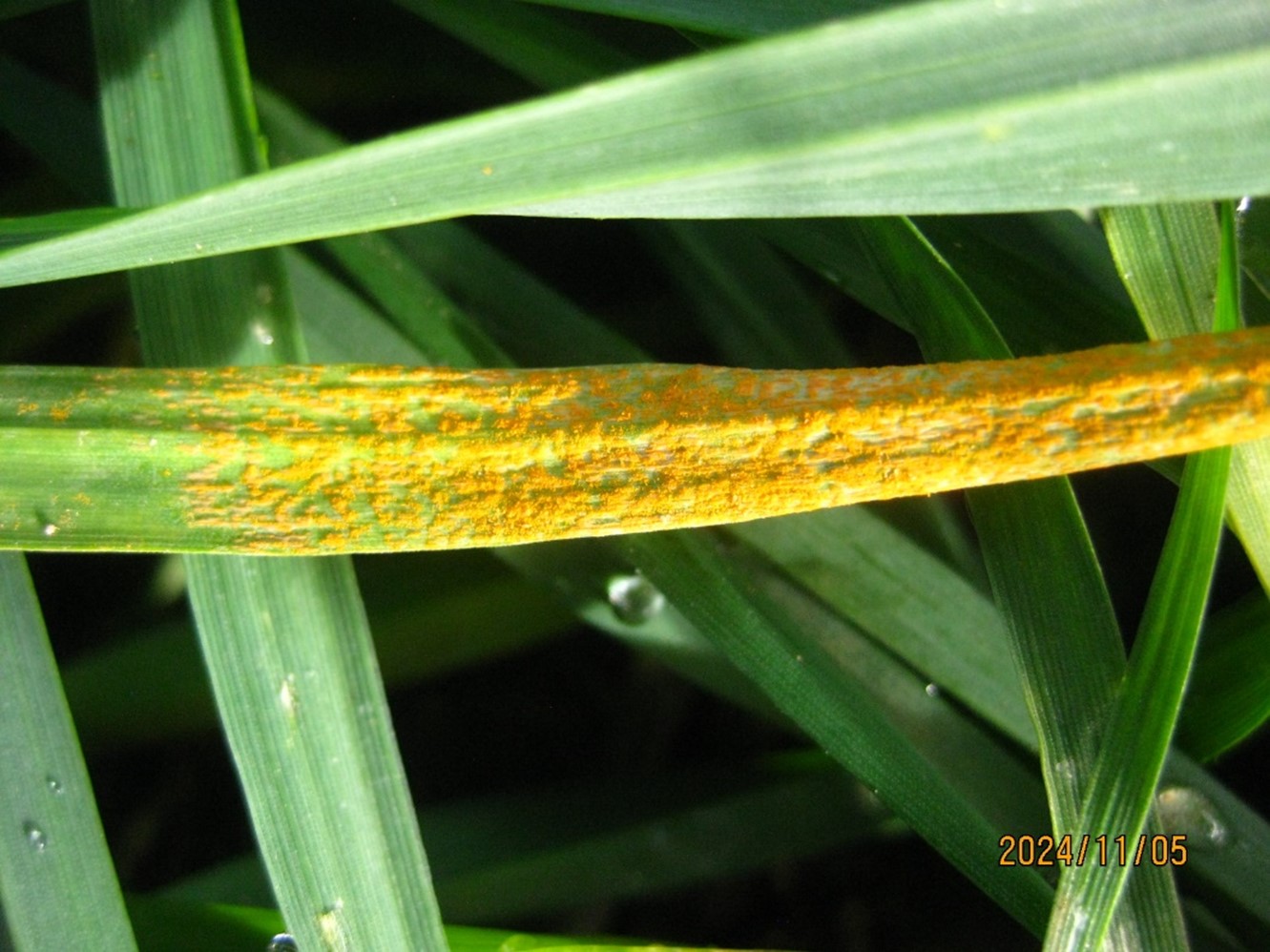
On November 5, we were checking wheat fields in Whitman, Adams, Lincoln, Douglas, and Grant counties in eastern Washington. Winter wheat generally had very good emergency with plants ranging from early tillering (Feekes 2) to early jointing (Feekes 5).  We checked over 30 fields with big plants (Feekes 3-5) and found only two stripe rust-infected leaves in one field along Highway 2 in Lincoln County (Figure 1). Whether the stripe rust fungus in the infected field is able to survive the winter or not will depend upon how cold of the winter and snow cover.  We will provide stripe rust forecasts based on the winter weather data and conduct field survey in the early spring.
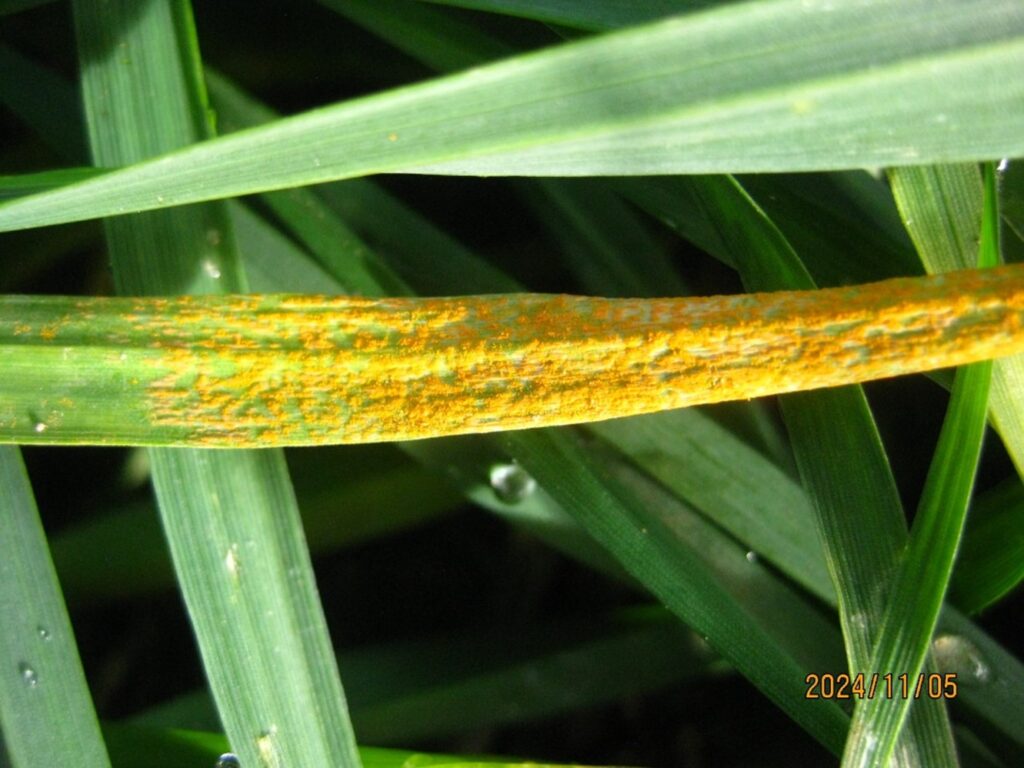
This photo is showing a stripe rust infection of 8 on a wheat leaf. Where the rust is covering the leaf with no necrosis present. The date on this photo is 11/05/2024

Figure 1.  Stripe rust observed in a winter wheat field in Lincoln County, Washington on November 5, 2024.