Xianming Chen
A. Stripe rust is forecasted in the upper range of severe epidemics for the eastern Pacific Northwest
Wheat stripe rust is forecasted to be in the upper range of severe epidemic (40-60% yield losses on susceptible varieties) in the 2026 growing season for the eastern Pacific Northwest, based on the predication models using the weather data from November 2025 to February 2026. The models predict highly susceptible varieties to have 55.8% yield loss with a standard deviation of 6.2%. This value is like the 56.7% yield loss forecasted in January based only on the November-December weather data. According to these predictions, commercially grown varieties will likely have up to 40% yield losses, or 8% yield loss on average for commercially grown varieties without fungicide application.
B. Stripe rust is widespread, and the pathogen is actively producing spores in central Washington
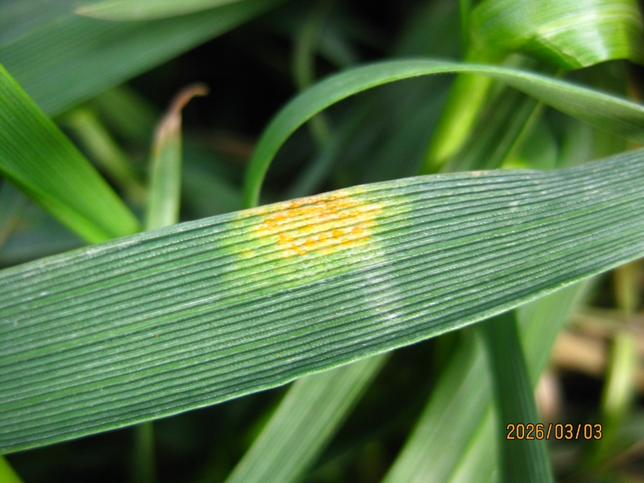
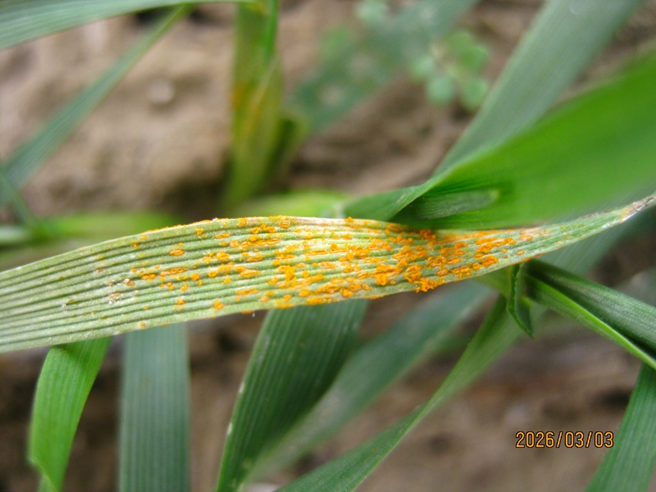
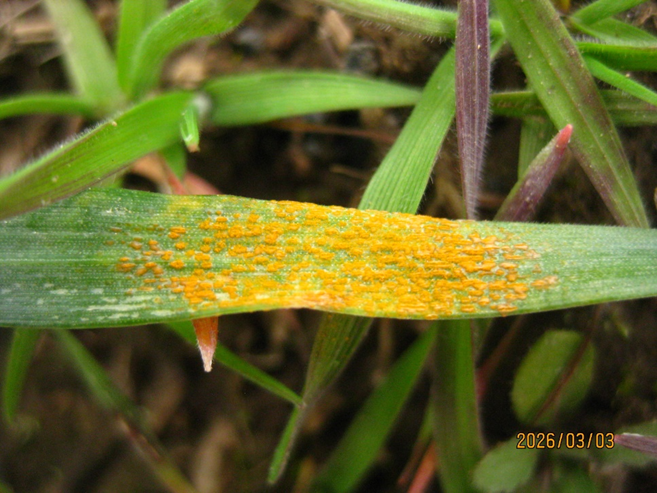
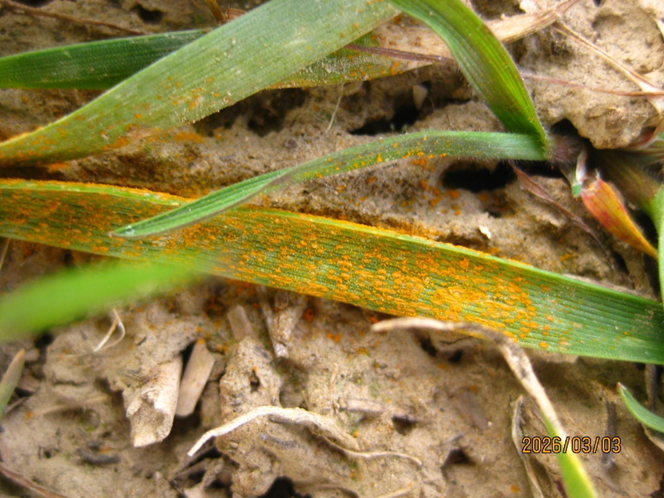
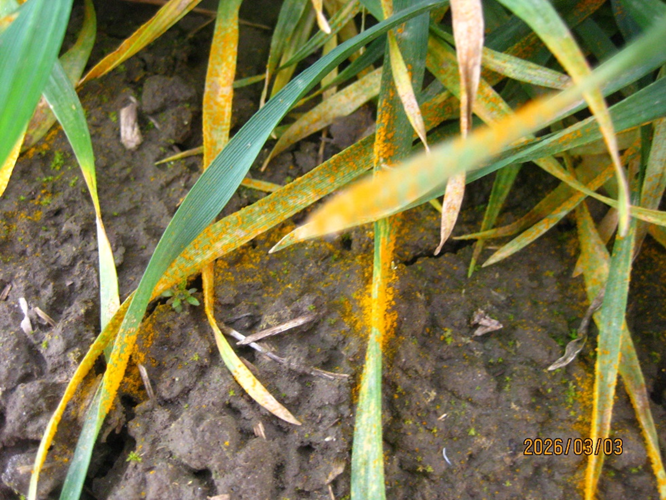
On March 3, we were checking winter wheat fields in Whitman, Lincoln, Adams, Franklin, and Walla Walla counties and found stripe rust in all these counties except Whitman (including our experimental fields near Pullman). Rust incidence and severity were more in the south than the north, correlating to the temperature patterns. In Lincoln County, we found stripe rust in 7 out of 10 commercial fields. Most of rust pustules were in the dormant stage with few active pustules (Figure 1). In the Adams and Franklin counties, active stripe rust pustules producing spores (Figure 2, Figure 3) were found in every checked field (8 or 9 fields checked in each county). In our experimental field at the Lind station (Adams Co.), stripe rust reached 50% incidence (Figure 4). Stripe rust was more severe in our experimental field in Walla Walla, with incidence over 80% and rust reaching top leaves (Figure 5). This is the most widespread and severe stripe rust by this time of year in Washington since 2011.
C. Recommendations for managing stripe rust in the eastern Pacific Northwest
The field observations show the unusually early development of stripe rust, and the predictions indicate high potential yield losses in the 2026 wheat crop season for the eastern Pacific Northwest. Fungicide application is recommended for the winter wheat fields planted with moderately resistant to susceptible varieties with stripe rust ratings 3 to 9 at the time of herbicide application, and a second application may be needed 20 to 30 days after the first application, which can be determined by whether active stripe rust appears in the field after the first application. As many resistant varieties (stripe rust ratings 1 and 2) have only high-temperature adult-plant (HTAP) resistance, which will not be effective until the weather gets warm and plants reach the middle jointing stage (Feekes 7), stripe rust can develop on these varieties. Therefore, any wheat fields should be checked for stripe rust. If active rust like those shown in the figures above, fungicide should be applied at the timing of herbicide application. Refer to my previous report “2026 First Stripe Rust Forecast for the Eastern Pacific Northwest” for stripe rust ratings of wheat varieties (https://striperust.wsu.edu/2026/01/07/2026-first-stripe-rust-forecast-for-the-eastern-pacific-northwest/).
For spring wheat, resistant varieties (stripe rust ratings 1 or 2) should be selected for planting. If for any reason varieties in the other categories (stripe rust ratings 3 to 9) are going to be planted, fungicide application will be likely needed at the time of herbicide application.
To select fungicides, please refer to the Appendix Table for information on active ingredients, application rate, control effect, effective duration, total limit per crop, and stage or date of application restriction.
D. Stripe rust in the country
In 2026, stripe rust was first reported in central Washington on January 15, Pendleton, Oregon (Umatilla County), on January 27, Davis, California (Yolo County) on February 9, and the Hill and McLennan counties, Texas on January 12. The observations of stripe rust in the Davis area of California were also unusually earlier than normal. The occurrence of stripe rust in Texas in January is an indication of severe epidemic in the southern Great Plains and potentially epidemics in the central and northern parts of the Great Plains.
Appendix Table
| Fungicides for control of stripe rust and other foliar diseases on cereal crops | ||||||
| Trade name | Active ingredient(s) (%) | Application rate (fl. oz/A) | Control effecta | Effective duration (days) | Total limit per crop (fl. oz/A) | Application restriction (no later than) |
|---|---|---|---|---|---|---|
| Absolute 500 SC | Tebuconazole 22.6, Trifloxystrobin 22.6 | 5.0 – 7.7 | VG | 35 | 32 | 35 dbhb |
| Aframe Plus | Azoxystrobin 13.5, Propiconazole 11.7 | 10.5 – 14 | E | 40 | 28 | Feekes 10.5.4 |
| Alto 100 SL | Cyproconazole 8.9 | 3.0 – 5.5 | VG | 30 | 5.5 | 30 dbh |
| Aproach SC | Picoxystrobin 22.5 | 6.0 – 12.0 | VG | 30 | 36 | Feekes 10.5 |
| Aproach Prima SC | Cyproconazole 7.17, Picoxystrobin 17.94 | 3.4 – 6.8 | E | 40 | 6.8 | 45 dbh |
| Aprovia Ace | Propiconazole 12.07, Benzovindiflupyr 7.24 | 9.45 | E | 40 | 18.9 | Feekes 10.5.4 |
| Avaris 2XS | Propiconazole 11.7, Azoxystrobin 7.0 | 10.5 – 14.0 | E | 40 | 56 | 30 dbh |
| Bumper 41.8 EC | Propiconazole 41.8 | 4 | VG | 30 | 8 | Feekes 10.5 |
| Caramba 0.75 SL | Metconazole 8.6 | 10.0 – 17.0 | E | 40 | 34 | 30 dbh |
| Custodia | Tebuconazole 18.3, Azoxystrobin 11.0 | 6.4 – 8.6 | E | 40 | 8.6 | Feekes 10.5 |
| Embrace | Tebuconazole 38.7 | 4 | – | – | 4 | 30 dbh |
| Equation 2.08 SC | Azoxystrobin 22.8 | 4.0 – 12.0 | VG | 30 | 24 | Feekes 10.54 |
| Evito 480 SC | Fluoxastrobin 40.3 | 2.0 – 4.0 | VG | 20 | 8 | Feekes 10.5 and 40 dbh |
| Fitness | Propiconazole 41.8 | 4 | VG | 30 | 8 | Feekes 10.5 |
| Folicur 3.6 F | Tebuconazole 38.7 | 4 | E | 30 | 4 | 30 dbh |
| Fortix | Fluoxastrobin 14.84, Flutriafol 19.80 | 2-3 | VG | 30 | 12 | Feekes 10.5 |
| Headline SC | Pyraclostrobin 23.6 | 9 | VG | 20 | 18 | Feekes 10.5 |
| Lucento | Bixafen 15.55, Flutriafol 26.47 | 2-3 | E | 30 | 6 | 30 dbh |
| Miravis Ace | Pydiflumetofen 13.7, Propiconazole 11.4 | 13.7 | E | 30 | 27.4 | Feekes 10.5.4 |
| Monsoon | Tebuconazole 38.7 | 4 | – | – | 4 | 30 dbh |
| Muscle 3.6 F | Tebuconazole 38.7 | 4 | E | 30 | 4 | 30 dbh |
| Nexicor EC | Propiconazole 11.73, Fluxapyroxad 2.81, Pyraclostrobin 18.76 | 13 | E | 40 | 26 | Feekes 10.5 |
| Onset 3.6 L | Tebuconazole 38.7 | 4 | – | – | 4 | 30 dbh |
| Orius 3.6 F | Tebuconazole 38.7 | 4 | – | – | 4 | 30 dbh |
| Preemptor | Fluoxastrobin 14.84, Flutriafol 19.30 | 2-3 | G | 20 | 12 | Feekes 10.5 |
| Priaxor 500 SC | Fluxapyroxad 14.3, Pyraclostrobin 28.6 | 8 | VG | 30 | 16 | Feekes 10.5 |
| Proline 480 SC | Prothioconazole 41.0 | 4.3 – 5.0 | VG | 30 | 9.37 | 30 dbh |
| Propiconazole E-AG 41.8 EC | Propiconazole 41.8 | 4 | – | – | 8 | Feekes 10.5 |
| PropiMax 3.6 EC | Propiconazole 41.8 | 4 | – | – | 8 | Feekes 10.5 |
| Prosaro 421 SC | Prothioconazole 19.0, Tebuconazole 19.0 | 6.5 – 8.2 | E | 30 | 8.2 | 30 dbh |
| Quadris 2.08 SC | Azoxystrobin 22.9 | 4.0 – 12.0 | E | 30 | 24 | 45 dbh |
| Quilt 200 SC | Propiconazole 11.7, Azoxystrobin 7.0 | 10.5 – 14.0 | E | 40 | 28 | Feekes 10.5 |
| Quilt Xcel 2.2 SE | Propiconazole 11.7, Azoxystrobin 13.5 | 10.5 – 14.0 | E | 40 | 28 | Feekes 10.5 |
| Stratego 250 EC | Prothioconazole 11.4, Trifloxystrobin 11.4 | 10 | VG | 30 | 20 | Feekes 10.5 and 35 dbh |
| Stratego YLD | Prothioconazole 10.8, Trifloxystrobin 32.3 | 4 | VG | 30 | 8 | Feekes 10.5 and 35 dbh |
| Tebucon 3.6 F | Tebuconazole 38.7 | 4 | – | – | 4 | 30 dbh |
| Tebustar 3.6 F | Tebuconazole 38.7 | 4 | – | – | 4 | 30 dbh |
| Tebuzol 3.6 F | Tebuconazole 38.7 | 4 | – | – | 4 | 30 dbh |
| Tegrol | Tebuconazole 38.7 | 4 | – | – | 4 | 30 dbh |
| Tilt 3.6 EC | Propiconazole 41.8 | 4 | VG | 30 | 8 | Feekes 10.5 |
| Toledo 3.6 F | Tebuconazole 38.7 | 4 | – | – | 4 | 30 dbh |
| Topguard | Flutriafol 11.8 | 10.0 – 14.0 | E | 30 | 28 | 30 dbh |
| Topguard EQ | Azoxystrobin 25.30, Flutriafol 18.63 | 3-4 | E | 30 | 9 | 30 dbh |
| Trivapro | Benzovindifluryr 2.9, Azoxystrobin 10.5, Propiconazole 11.9 | 9.4 – 13.7 | E | 40 | 27.4 | 10.5.4 |
| Twinline 1.75 EC | Metconazole 7.4, Pyraclostrobin 12.0 | 7.0 – 9.0 | E | 40 | 18 | Feekes 10.5 |
| Vertisan | Penthiopyrad 20.6 | 24 | E | 40 | 48 | Feekes 10.5.1 |
| Viathon 5.1 SC | Tebuconazole 3.3, Potassium phosphite 49.0 | 2.0 pt | E | 30 | 16.5 | 30 dbh |
| Zolera FX | Fluoxastrobin 17.76, Tetraconazole 17.76 | 3-5 | VG | 30 | 5 | Feekes 10.5 |
| a E = excellent, G = good, VG = very good, and – = no information from our tests. | ||||||
| b dbh = days before harvest. | ||||||